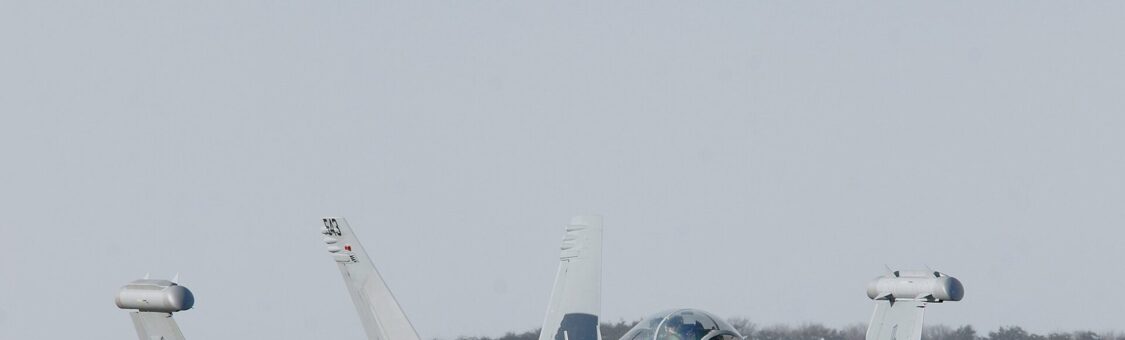
The U.S. Navy has added $876.4 million to L3Harris Technologies’ contract for the Next Generation Jammer Low Band, a radar-jamming pod for the EA-18G Growler electronic attack jet, the U.S. Department of War announced. The modification covers continued development, tooling, equipment, labor, test pods, cybersecurity, logistics, testing and software support for both the U.S. Navy and the Royal Australian Air Force. Work is scheduled to finish in fiscal 2031.
The award is a modification to the $587.4 million contract Naval Air Systems Command gave L3Harris in August 2024 to take the jammer through engineering and manufacturing development, the final stage before production. The new money is larger than that original award.
The modification is undefinitiated, meaning the Navy authorized the work before final terms and price were agreed. It is a cost-plus-incentive-fee deal, which reimburses L3Harris’s costs and pays a fee tied to performance targets. The Navy did not compete it.
At the time of award, the Navy obligated $3.65 million in fiscal 2026 research and development funds, while the Royal Australian Air Force contributed $23 million in cooperative funds. Most of the work, 43%, will take place at L3Harris’s facility in Salt Lake City. The rest is spread across sites in Alabama, Pennsylvania, New Jersey, Colorado, California, New York and Texas, with 3.4% performed in Australia.
The Growler is a modified F/A-18F Super Hornet built to jam and disrupt enemy radars and communications. Its main jamming system has long been the AN/ALQ-99 pod, first fielded in the 1970s. The Navy is replacing it with a family of Next Generation Jammer pods, each covering a different part of the radio spectrum. RTX’s Raytheon builds the mid-band pod, the AN/ALQ-249, which already flies with the fleet. L3Harris’s low-band pod targets lower-frequency search radars, which can spot aircraft at long range and cue long-range missiles toward them.
L3Harris says the pod will let Growler crews suppress enemy air defenses with high-power jamming from standoff ranges, keeping the aircraft farther from the threats they are attacking. Suppliers are already delivering hardware. In July, CPI Aerostructures of Edgewood, New York, received a $13.6 million contract from L3Harris to build pod structures for operational prototypes and extra test units. Honeywell Aerospace joined the program in June 2025, and Marotta Controls announced contracts to support it.
Sources: Military.com · DVIDS News