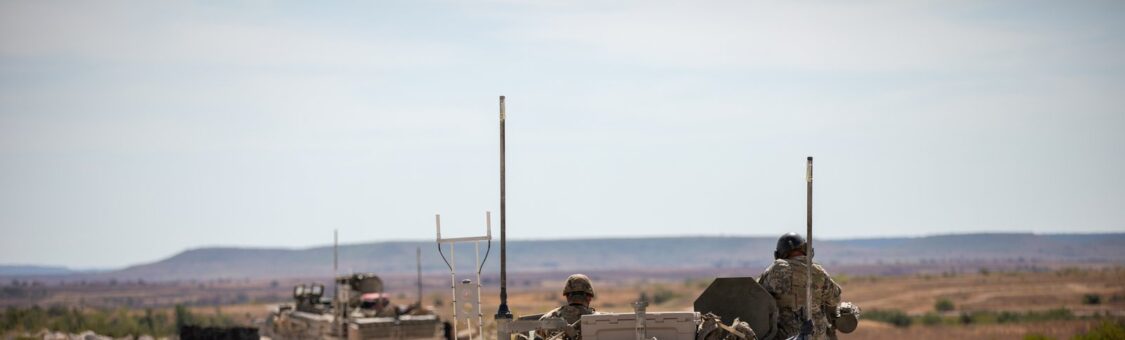
New footage shows the U.S. Army’s next-generation M1E3 Abrams tank and two XM30 infantry fighting vehicle prototypes firing live rounds, offering one of the first public looks at the vehicles in action. The footage was shared on LinkedIn by Alexander Miller, chief technology officer to the U.S. Army chief of staff, who said he went hands-on with the M1E3 pre-prototype, one of the XM30 offerings, the Mobile Tactical Cannon and new optics, and watched robots from the Army’s Operation Jailbreak Falcon Fury shoot down drones. He did not say where the event took place or name the units involved.
M1E3 Abrams
The M1E3 is the Army’s redesign of its main battle tank, launched in 2023 after the service cancelled a planned SEPv4 upgrade to the current Abrams. The first early prototype was unveiled at the Detroit Auto Show in January. It has an uncrewed turret with an autoloader, a three-person crew seated in the hull, digital controls and an open systems architecture meant to allow quick hardware and software updates. Four pre-prototypes built by Roush are due to reach the 1st Armored Brigade Combat Team, 1st Cavalry Division, known as the Iron Horse brigade, at Fort Hood, Texas, later this year, with General Dynamics Land Systems delivering more.
XM30 Competition
The XM30 Mechanized Infantry Combat Vehicle competition pits General Dynamics Land Systems’ Wolf against American Rheinmetall’s Lynx-based design. Both companies delivered their first prototypes at the end of August and the start of September, and each is building eight. The two designs are headed to the same Iron Horse brigade for soldier testing, including a National Training Center rotation in spring 2027, and the Army could pick a winner after that.
Other Programs
The Mobile Tactical Cannon is the Army’s program to replace the towed M777 howitzer with a wheeled, self-propelled 155 mm gun that can fire and move quickly. In August, the service picked Hanwha Defense USA’s K9 Mobile Howitzer, ordering six prototypes with an option for 12 more.
Miller used the post to argue that cheap, numerous systems still matter alongside expensive ones.
“Mass still matters. Pretending that it doesn’t is risk blindness and academics. To take and hold land you need mass – affordable mass, with autonomy, mission planning at superhuman scale and speed, and execution at echelon,” said Alexander Miller.
“We should always make the first engagement with any adversary a trade for blood and steel. Their blood, our steel,” Miller said.
He also pointed to the networks behind the vehicles. Miller said the Next Generation Command and Control program provides the data platform for tools and applications, while the Integrated Battle Command System-Maneuver handles fire control and asset management for counter-drone sensors and weapons. Cheap, attritable drones flow to units from the Defense Innovation Unit’s Drone Dominance Program through a drone marketplace, he wrote.
Power is a growing problem for troops in the field, Miller added.
“Soldiers draw between 60-120W depending on their loadout. That’s nearly continuous. When you get to a squad you’re at almost a kW of draw – that’s before drone batteries,” Miller said.
He said mobile power that does not give away troops through visual, acoustic or infrared signatures is critical. Operation Jailbreak is the Army’s push to make sensors, weapons and software from different companies work together, starting with counter-drone and air defense systems. Miller did not say which robots took part or what weapons they used against the drones.
The Army has not said when M1E3 testing with the Iron Horse brigade will begin or released results from the live-fire event.
Sources: DVIDS News · DVIDS News