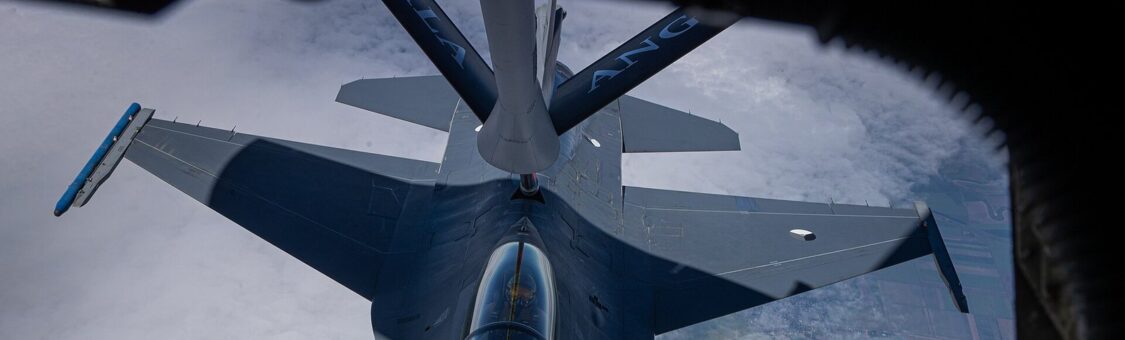
The first-ever F-16 Block 72 has completed its maiden flight, marking a major milestone for the program and for Morocco’s effort to field what Lockheed Martin describes as the most advanced version of the Viper. The aircraft, a two-seat F-16D for the Royal Moroccan Air Force (RMAF), flew at Lockheed Martin’s facility in Greenville, South Carolina, the company announced Oct. 6, 2026. The jet will now proceed through flight testing ahead of delivery to Morocco.
Morocco was the first customer to select the Block 72 configuration when the U.S. government approved its purchase in March 2019. At that time, the Defense Security Cooperation Agency said Morocco was seeking 25 F-16C/D Block 72 aircraft in a package estimated at $3.787 billion. The proposed aircraft were to be equipped with the AN/APG-83 Scalable Agile Beam Radar, an active electronically scanned array type, new mission computers, Link 16 Multifunctional Information Distribution Systems, modernized navigation systems, helmet-mounted cueing systems, and a range of air-to-air and air-to-ground weapons.
The distinction between the Block 70 and Block 72 is the engine. The Block 70 uses General Electric’s F110-GE-129, while the Block 72 uses Pratt & Whitney’s F100-PW-229, providing fractionally more power. The two configurations otherwise share the same major avionics and systems modernization package.
For Morocco, the choice of the Block 72 is based on ensuring as much fleet commonality as possible. The RMAF already operates F-16C/D Block 52+ aircraft powered by F100 engines, making the new aircraft a natural fit within its existing support infrastructure. Morocco is also upgrading its existing F-16 fleet to the F-16V configuration, which is broadly similar to the new-build Block 70/72 standard. A separate notification in March 2019 covered the upgrade of Morocco’s existing 23 F-16C/D Block 52+ aircraft to the F-16V standard.
One of the photos published by Lockheed Martin shows the pilot in the front cockpit wearing a Digital Joint Helmet Mounted Cueing Systems (D-JHMCS), an advanced helmet not often seen worn by F-16 pilots, and it is not clear if it has been ordered by Morocco.
The Block 70/72 has attracted customers across Europe, the Middle East, Asia, and elsewhere, including Bahrain, Bulgaria, Jordan, Peru, the Philippines, Slovakia, and Taiwan.
Sources: The War Zone · DVIDS News