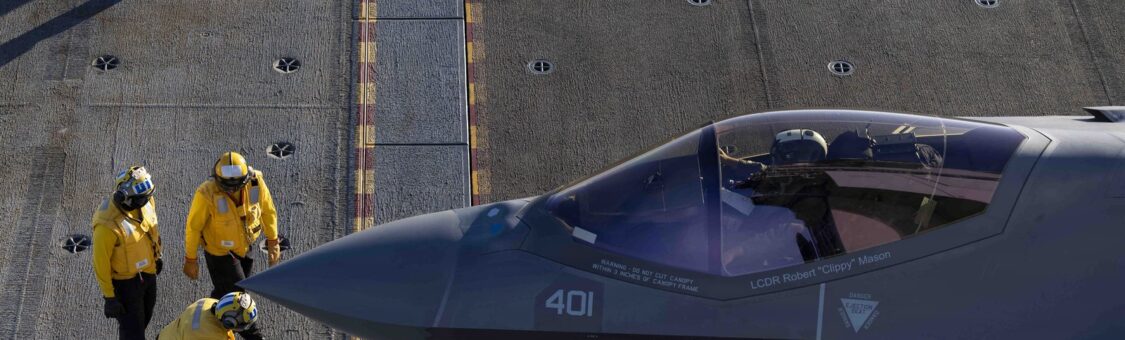
An F-35C Lightning II made an arrested landing on the pre-commissioning carrier John F. Kennedy (CVN 79) on Oct. 13, 2026, marking the first time an F-35C has landed on a Ford-class aircraft carrier, the U.S. Navy said.
The landing occurred during Aircraft Compatibility Testing (ACT), which assesses the ship’s launch and recovery equipment with Navy aircraft. The Kennedy uses the Electromagnetic Aircraft Launch System (EMALS) catapults and the Advanced Arresting Gear (AAG).
The F-35s used in the test were from the Patuxent River F-35 Integrated Test Force, attached to the “Salty Dogs” of Air Test and Evaluation Squadron (VX) 23. Two F-35s were visible in released images, with the second aircraft carrying inert GBU-38 Joint Direct Attack Munitions as external stores.
The Kennedy recently achieved preliminary acceptance by the Navy. The carrier is scheduled for delivery to the Navy in March 2027 and is due to be homeported at Naval Base Kitsap-Bremerton, Washington, which would make it the first Ford-class carrier based on the U.S. West Coast.
The lead ship of the class, USS Gerald R. Ford (CVN 78), completed its own ACT in January 2020 after 16 days at sea and the launch and recovery of 211 aircraft. The F-35C was the only aircraft type not included in the Ford’s ACT. The Navy has not released details about the Kennedy’s ACT campaign.
The Kennedy was laid down in 2015 and first sailed under its own power from the HII facility in Newport News, Virginia, on Jan. 28, 2026. The ship incorporates design changes compared to the Ford, including the AN/SPY-6(V)3 radar, and was built with modifications required to operate F-35C fighters that are missing on the Ford.
According to the Navy, the Kennedy is 1,092 feet in length and 100,000 tons, and incorporates more than 23 new technologies. The service says these innovations will support a 33% higher sortie generation rate compared to Nimitz-class carriers. The Navy also states the Ford class offers a reduction of approximately $4 billion per ship in life cycle operations and support costs over its 50-year service life, compared to the Nimitz class. The Navy said total ownership cost for a Nimitz-class ship is $32.1 billion in FY 04 constant year dollars, while a Ford-class carrier is expected to cost $26.8 billion.
Sources: Defence Blog · DVIDS News