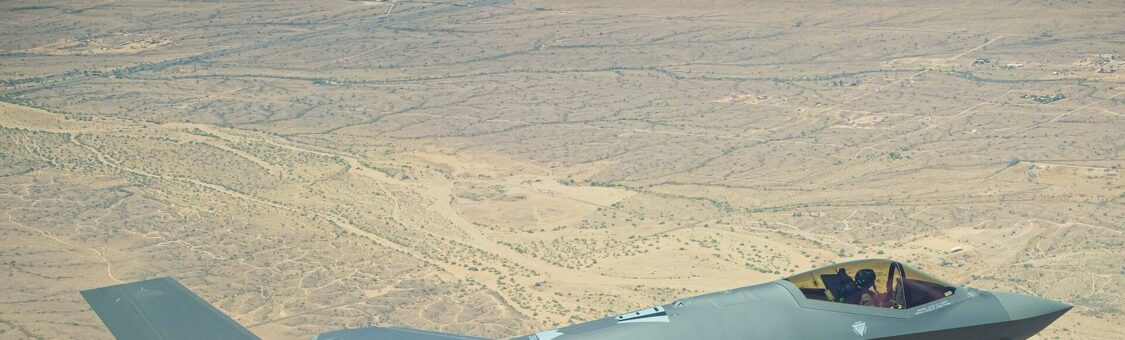
Royal Danish Air Force (RDAF) F-35A Lightning IIs landed at Kangerlussuaq Airport in Greenland on Sept. 16, 2026, marking the first deployment of the fighter to the territory, alongside U.S. Air Force F-16s and Royal Canadian Air Force (RCAF) CF-18s as part of NATO’s Arctic Sentry initiative.
The Danish Defence Command said the deployment was part of Arctic Sentry, an initiative launched in February 2026. The Danish contribution included several F-35s deployed from Keflavik, supported by a KC-135 Stratotanker, according to the Forsvaret.
The U.S. and Canadian aircraft operated from Goose Bay in Canada before moving to Greenland under Operation Arctic Vanguard, a NORAD deployment. The Alaskan NORAD Region moved F-16s from Eielson Air Force Base to Goose Bay, in Canada’s Newfoundland and Labrador province, for Operation ARCTIC VANGUARD 26-4.2. Royal Canadian Air Force strategic airlift supported the move. NORAD said the deployment tests whether it can move multirole combat aircraft from Alaska to forward Arctic locations, stage them through northeastern Canada, and keep them flying in sub-zero weather with little support infrastructure. The command has not released results or said how many F-16s or personnel are involved, or where in Greenland they will operate.
Images released by the Danish Defence, DVIDS and NATO show two RDAF F-35As, four USAF F-16s and two RCAF CF-18s arrived at Kangerlussuaq airport. The Forsvaret emphasized the challenges associated with the multinational, long-range deployment in extreme Arctic conditions. The F-16s are not the only U.S. fighters working in Greenland under the same operation name; F-35A fighters from the Wisconsin Air National Guard’s 115th Fighter Wing had flown missions from Pituffik Space Base under Operation Arctic Vanguard. In October 2025, NORAD sent two F-35s, two F-16s and three KC-135s for an exercise meant to test how quickly it could deploy forces to the Arctic.
Separately, Denmark, Greenland and the United States are set to sign a deal on Greenland’s security on Tuesday, an agreement Denmark says will put Arctic security under NATO’s watch rather than leaving it solely to Washington and Copenhagen. The agreement, expected to be signed at the UN General Assembly in New York, has not been made public. Danish Foreign Minister Lars Lokke Rasmussen told national broadcaster TV2 that “it (the agreement) will be in a form where responsibility for security in the Arctic is not only Danish or American,” adding that to a large extent “it would be NATO that looks after the Arctic.” A NATO spokesperson said on Saturday the alliance welcomed the agreement, which would “help advance security, stability and cooperation in this vital region.”
President Donald Trump said in a post on Truth Social on Friday the agreement gives the United States “permanent control over security, and all other needs, in Greenland,” and that no U.S. adversary could have a base or military presence there without Washington’s written approval. Denmark has not responded to Trump’s claim, though Copenhagen has earlier acknowledged it underinvested in Greenland’s defense for decades and has pledged to expand its military presence on the island, including more NATO troops. Key details have not been made public, including whether the deal amends the 1951 defense agreement that is the legal basis for the U.S. presence.
NORAD has not said how long the F-16s will stay in Greenland or when they will return to Alaska.
Sources: US Army · Defense News