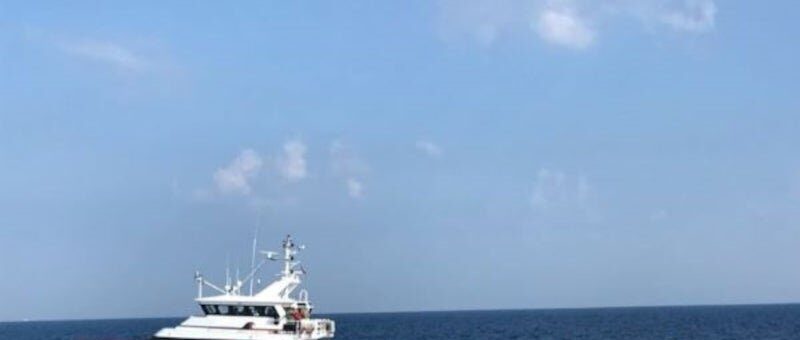
The U.S. Navy announced Sept. 29 that it is procuring 30 medium unmanned surface vessels (MUSVs) under its Medium Unmanned Surface Vessel Family of Systems program, awarding contracts to Galliano Marine Services, Huntington Ingalls Industries (HII), and Saronic Technologies. Each company will build 10 vessels at an average procurement cost of $40 million per vessel, for a total of approximately $1.2 billion, according to Chris Miller, the Navy’s Acting Direct Reporting Portfolio Manager for Robotic and Autonomous Systems.
The awards were made under Other Transaction Authority (OTA) agreements, a contracting mechanism intended to support rapid prototyping and research and development. The contracts follow successful at-sea testing under Phase I of the MUSV program, in which seven companies competed. The other competitors—Birdon, Leidos, PacMar Technologies, and Sea Machines—completed testing but did not receive production awards.
“The awards mark a significant step forward in translating the strategic vision into a tangible fleet capability,” Miller said at a media roundtable. “Each agreement is for the procurement of 10 MUSV at an average procurement cost of $40 million per vessel.”
Production will begin immediately at shipyards in Loreauville, Houma, and Franklin, Louisiana, with deliveries starting as early as the fourth quarter of fiscal year 2027, Miller said.
The Phase I at-sea testing evaluated the vessels’ ability to perceive the maritime environment, navigate autonomously according to international collision regulations, and conduct long-duration missions. The long-duration test required each vessel to operate for roughly 26 hours and cover more than 360 nautical miles with only a single input from a command-and-control station, Miller explained. The awards were based on “the optimal mix of autonomy, performance, design, production schedule, and cost,” he added.
Phase II of the program will allow entrants to compete and existing vendors to submit updated product blocks and modular payload configurations. Testing evaluations will begin as early as Nov. 16, and proposals will be assessed on a rolling basis over the next five years, Miller said. He also noted that speed and at-sea refueling targets from Phase I were eliminated based on lessons learned.
Phase II requirements include designs no longer than 295 feet (90 meters) and displacing no more than 5,000 metric tons, the ability to carry at least two 20-foot equivalent unit containerized payloads weighing 24,000 kg each and consuming 25 kW each, and the capability for multi-day unmanned operations of at least 10 days. Vessels must be operable in NATO STANAC 4194 Sea State 4 and survivable in Sea State 6.
Sources: USNI News · The War Zone