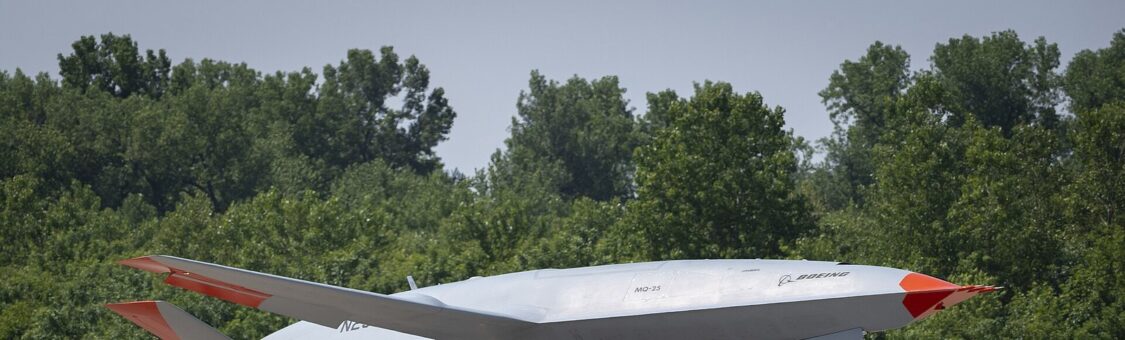
The U.S. Navy said an aircraft carrier remotely controlled an MQ-25A Stingray unmanned refueling aircraft from more than 2,100 miles away, using a satellite link during a test in the Pacific Ocean.
Acting Secretary of the Navy Hung Cao announced the trial on Oct. 19, 2026. During the Preliminary Sea Trial aboard the Nimitz-class carrier USS Ronald Reagan (CVN 76), the ship’s Unmanned Air Warfare Center connected to an MQ-25A test aircraft at Boeing’s facility in Mascoutah, Illinois, through a Proliferated Low Earth Orbit (pLEO) satellite network. The aircraft was controlled from the ship’s MD-5C Ground Control Station.
The Navy described the event as a first and part of a series of build-up exercises designed to validate procedures, networks and interfaces. The release did not specify when the test took place or which Stingray airframe was used. Previously, the Unmanned Carrier Aviation Program Office’s (PMA-268) Unmanned Carrier Aviation Mission Control System team had conducted pier-side and at-sea tests with the MQ-25 Integrated Test Team, which includes the U.S. Navy, Boeing and Lockheed Martin.
The MD-5C Ground Control Station integrates the Navy’s Command, Control, Communications, Computers and Intelligence (C4I) network with Lockheed Martin’s MDCX hardware and software, according to the Navy. The system will also provide command and control for the Navy’s future unmanned carrier aircraft and the Air Wing of the Future.
“We have redefined naval power projection,” said Capt. Daniel Fucito, PMA-268’s program manager. “This first-ever underway connection between a carrier-based UAWC and an MQ-25A aircraft proves that the Carrier Air Wing of tomorrow is a reality today.”
Cao said the Stingray’s carrier-based refueling capabilities enable F/A-18 Super Hornets to fly farther and longer. “The integration of this unmanned aerial refueler demonstrates the transformational change our manned and unmanned asset integration provides the Fleet,” he said in the Navy release.
In a separate milestone announced by Boeing on Oct. 6, the Stingray moved closer to teaming with fleet aircraft: the company said it successfully tested Manned-Unmanned Teaming (MUM-T) command and control software using the Link 16 datalink during the Emerald Flag exercise at Eglin Air Force Base, Florida. The software was installed on a Beechcraft 1900D and a King Air E90 for the demonstration. Boeing plans to integrate the capability with the MQ-25A and F/A-18 Super Hornet after further testing.
The test is broadly in line with the Navy’s previous timeline to achieve MQ-25A carrier integration by 2026, according to The Aviationist. In 2024, the USS George H.W. Bush (CVN 77) became the first carrier to receive an Unmanned Air Warfare Center with an MD-5E Ground Control Station. In September 2026, the Navy awarded Boeing a $562 million contract for Lot 1 of the Stingray’s Low-Rate Initial Production, bringing the total number of Stingrays under contract to 14.
The Navy said the MQ-25A, described as the world’s first fully integrated carrier-based unmanned aerial vehicle, serves as a pathfinder for future unmanned carrier aviation. The service said the Stingray will provide the Carrier Air Wing with organic refueling, allowing more F/A-18E/F aircraft to focus on strike missions and expand the air wing’s operational reach.
Sources: The Aviationist · Defence Blog