News

News

Air Force Completes First Airbase Training Range for Basic Military Training
163d RTS Conducts Multi-day Readiness Training for the 146th CES (SMSgt Julianne Sitterding)

Air Force Completes First Airbase Training Range for Basic Military Training

The U.S. Air Force is putting the finishing touches on its first airbase training range for Basic Military Training (BMT), a notable modernization of the service’s entry-level training to reflect the realities of contested airbase operations, according to Air & Space Forces Magazine. The range is the first of what the service plans to be multiple such facilities.

What the Range Includes

The new training range incorporates F-16 and C-130 aircraft elements to give basic trainees exposure to real airbase operating environments. The range is designed to prepare trainees for the conditions they may face at deployed or contested airbases, moving beyond the traditional classroom and drill-focused BMT curriculum.

Air & Space Forces Magazine reported on Sept. 11, 2026, that the Air Force is completing the range and has plans for additional ranges to be built. The publication did not specify the exact location of the first range or the total dollar amount invested in the project.

Modernizing Basic Military Training

The development marks a shift in how the Air Force prepares its newest airmen. Historically, BMT has focused on discipline, physical fitness, and fundamental military skills. The addition of an airbase training range signals an intent to familiarize trainees with the operational environment earlier in their careers.

According to the source, the range is part of a broader effort to update BMT to reflect contested airbase operations—a concern that has grown as potential adversaries have developed capabilities to strike airfields and other fixed installations.

The Air Force has not publicly released a detailed timeline for when the first range will be fully operational or how many ranges are ultimately planned. Air & Space Forces Magazine described the current status as “finishing touches,” indicating the first range is near completion.

Why It Matters

The investment in airbase training ranges for basic trainees reflects a recognition that airmen at all levels may face threats at their home stations or deployed locations. By exposing recruits to airbase operations and aircraft like the F-16 and C-130 during their initial training, the Air Force aims to build a more operationally aware force from day one.

Sources: The War Zone · Air & Space Forces Magazine · Air & Space Forces Magazine · DVIDS News
News

Pentagon Expands Border Tech Testbed as Army Pushes Services on Laser Weapons
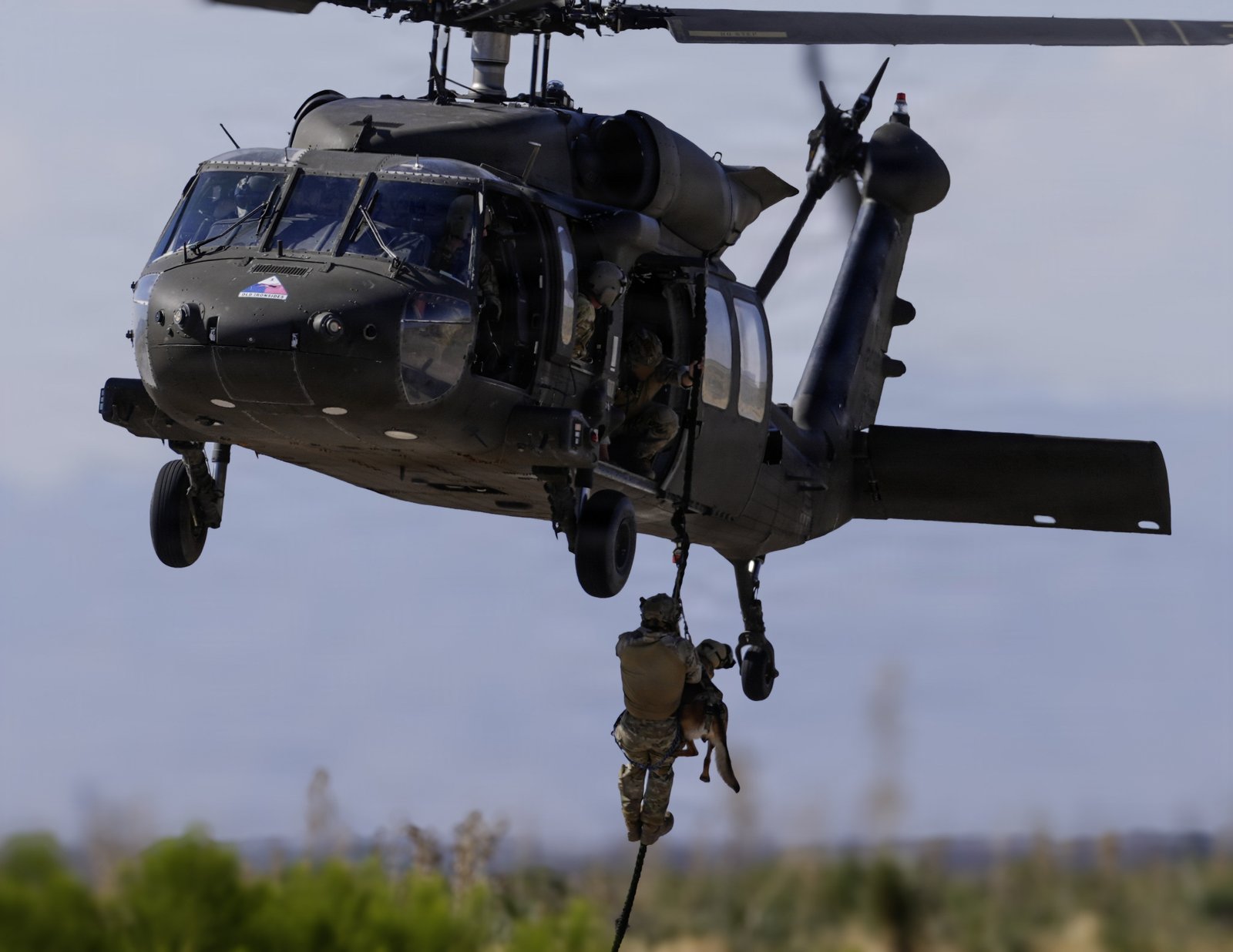
1AD CAB conducts FRIES training with BORTAC in preparation of U.S. southern border support (SGT Jacob Suess)

Pentagon Expands Border Tech Testbed as Army Pushes Services on Laser Weapons

WASHINGTON — The Pentagon is expanding its technology testbed along the US-Mexico border, with senior officials eyeing new unmanned surface vessels in the Gulf of Mexico, more automated aerial drones, and possible unmanned ground vehicles — all contingent on funding still being negotiated on Capitol Hill.

Mark Ditlevson, assistant secretary of defense for Homeland Defense and Americas Security Affairs, told Breaking Defense on Wednesday that the department wants to bring new projects to the border “in a responsible way that’s safe,” but noted that “major negotiations” over the fiscal 2027 budget are ongoing. Congress has passed a continuing resolution to fund the department from Oct. 1 through early December, while lawmakers debate a $1.15 trillion base budget and a separate $350 billion reconciliation deal that appears increasingly unlikely to pass in its current form.

The department has already deployed 10 Lightfish unmanned surface vessels to monitor the Rio Grande river area as part of a broader autonomy and network integration project. After receiving “positive feedback,” Ditlevson said he wants to push USVs into the Gulf of Mexico to support counter-narcotics operations, with a notional mission running “from the mouth of the Rio Grande across to Key West.” No timeline for that deployment has been set.

On the software side, the Pentagon aims to fold Joint Interagency Task Force-401’s Counter-Unmanned Aerial Systems sensor architecture into border operations next year, integrating it with the DoD’s Maven Smart System and Lattice, as well as Customs and Border Protection’s Minotaur. “Hardware is awesome, but that software backbone also needs to be invested in,” Ditlevson said.

Ditlevson also credited the Safer Skies Act, passed as part of the 2026 National Defense Authorization Act, with cutting red tape under Section 130i for counter-drone operations on US soil. He said measures have been put in place after a February incident in which the FAA shut down airspace around El Paso airport due to a miscommunication involving a counter-drone laser on loan from the Army to Customs and Border Protection. “That has been remedied, and I feel very confident in what we have for systems in place,” he said.

Pressure on Services for Laser Weapons

Separately, the Pentagon’s critical technology chief is pressing the military services to commit to the Joint Laser Weapon System program after the Army said it would transition within the next two years. Michael Dodd, assistant secretary of defense for critical technologies, said at the National Defense Industrial Association’s Emerging Technologies for Defense Conference on Wednesday that his office is committed to fielding directed energy systems within 24 months or less.

“I’ll say it here, I’m going to knuckle roll the other services to do the same,” Dodd said. The Defense Department has awarded two JLWS contracts to nLIGHT Defense and Lockheed Martin with an initial value of $86 million and a ceiling of $847 million. Earlier this month, the Army awarded AeroVironment a $464.8 million contract for its Enduring-High Energy Laser program, which company officials called the first production contract for directed energy weapon systems in American history.

Dodd said the cost per system remains high “because we’re not scaling the systems,” and argued that services need to procure directed energy weapons “by the dozens or hundreds” to make them cost-effective. “We’re shooting down $1,000 one-way attack drones with multi-million-dollar systems. It’s completely unsustainable,” he said.

Nuclear Microreactors for Fort Benning

In a separate energy resilience effort, the Army announced on Aug. 26 that Fort Benning, Georgia, will host three Radiant Industries Kaleidos microreactors under the Janus Program. The three 1-megawatt units will provide a combined 3 megawatts of backup power to Lawson Army Airfield and other critical infrastructure if the regional grid fails. Radiant has said it holds an Army contract worth up to $750 million to deploy 15 microreactor units across Janus sites. The Army is targeting 2028 for the first Janus microreactors to become operational.

The border testbed expansion and the directed energy push reflect a broader Pentagon effort to field emerging technologies faster and at scale, driven by cost pressures from drone threats and the operational demands of homeland defense missions.

Sources: Breaking Defense · Breaking Defense · DefenseScoop · Defence Blog

News

Anthropic: Iran-Linked Actors Used Claude to Target US Navy, Houthi-Held Yemen Sought Missile Guidance Help
Naval War College activity (James Foehl)

Anthropic: Iran-Linked Actors Used Claude to Target US Navy, Houthi-Held Yemen Sought Missile Guidance Help

An Iran-linked actor used Anthropic’s Claude artificial intelligence model earlier this year to collect and analyze publicly available data for targeting recommendations against U.S. naval forces in the Middle East, while a group in Houthi-held northern Yemen used the same model to assist with guidance systems for ballistic and hypersonic missiles, according to a threat intelligence report Anthropic released on Sept. 10, 2026.

The 154-page report, which Anthropic describes as its most detailed to date, covers the period between December 2025 and August 2026 and documents misuse of Claude across intelligence gathering, surveillance, cyberattacks, influence operations and biological research. Anthropic said actors behind the activity were based in Iran, Yemen, Russia, China and other countries.

Targeting U.S. naval forces

In a case study designated GTG-30005, Anthropic said it identified and disrupted an Iran-nexus threat actor that used Claude to compile targeting handbooks through a Python pipeline built with the model’s assistance. The compiled material included a roster of U.S. personnel scraped from captions on public military photographs, publicly accessible ship and aircraft transponder identifiers, commercial satellite-imagery query scripts, and an inventory of public websites that exposed U.S. naval movements.

The same actor directed Claude to compile vulnerability research on shipboard systems, cataloging known CVEs in maritime VSAT terminals, Cisco communications equipment and industrial control products. Anthropic said the account was separately tied to domestic mass surveillance software development work for Iranian state systems. The company banned the account, developed detections to reduce future misuse, and shared threat intelligence with government authorities.

Whether the collected data was used in actual attacks on U.S. forces is unknown, according to The War Zone. Recent media reports have described Iran increasingly attempting to strike American warships, raising questions about how Tehran tracks maritime targets far from its shores.

Yemen-based weapons development

In a separate case designated GTG-87001, Anthropic said it identified a cell of threat actors based in northern Yemen running three weapons development programs: a guided rocket using a commodity phone-class flight computer with final-phase homing guidance; a multi-stage ballistic missile with a stated range goal above 2,000 km; and a multi-variant missile referred to as the “R2000” set that included a hypersonic glide vehicle variant.

The actors used Claude Code in place of human software engineers to develop guidance, navigation and control software. They used the model to integrate an open-source autopilot onto a phone-class flight computer, write control and position estimation software, tune control settings, run a firmware build pipeline and perform flight simulations. The actors managed several Claude instances at once, assigning one to write code, another to research, and a third to review the first instance’s output.

Anthropic did not explicitly name the Houthis in the report, but the group in northern Yemen is very likely Iranian-backed Houthi militants, according to The War Zone. The Associated Press reported that northern Yemen is territory controlled by the Iran-backed Houthi rebels.

The report highlights how quickly AI tools are spreading into conflict zones, including among non-state actors with limited engineering capacity. Anthropic said it banned the accounts involved and shared findings with government authorities, but the cases show that commercially available AI models are now being used to compress weapons development timelines and lower the technical barriers for groups seeking advanced military capabilities.

Sources: The War Zone · Military.com · Navy Times

News

Anduril Unveils Next-Gen Interceptor Core

Anduril Unveils Next-Gen Interceptor Core

The new core moves target classification onto the airframe itself, cutting the round trip to ground control and keeping the intercept envelope intact when the link degrades.

News

Anduril Unveils Next-Gen Interceptor Core with Advanced Real-time Target Resolution

Anduril Unveils Next-Gen Interceptor Core with Advanced Real-time Target Resolution

The new core moves target classification onto the airframe itself, cutting the round trip to ground control and keeping the intercept envelope intact when the link degrades.

The new core moves target classification onto the airframe itself, cutting the round trip to ground control and keeping the intercept envelope intact when the link degrades.

Sed ut perspiciatis unde omnis iste natus error sit voluptatem accusantium doloremque laudantium, totam rem aperiam eaque ipsa quae ab illo inventore veritatis et quasi architecto beatae vitae dicta sunt, explicabo.

Neque porro quisquam est, qui dolorem ipsum quia dolor sit amet, consectetur, adipisci velit, sed quia non numquam eius modi tempora incidunt ut labore et dolore magnam aliquam quaerat voluptatem.

News

Autonomous Sentry Towers Complete 90-Day Trial on the Northern Perimeter

Autonomous Sentry Towers Complete 90-Day Trial on the Northern Perimeter

Three towers ran unattended through the full trial window, including two weeks of continuous precipitation and a nine-day stretch below freezing.

Three towers ran unattended through the full trial window, including two weeks of continuous precipitation and a nine-day stretch below freezing.

Sed ut perspiciatis unde omnis iste natus error sit voluptatem accusantium doloremque laudantium, totam rem aperiam eaque ipsa quae ab illo inventore veritatis et quasi architecto beatae vitae dicta sunt, explicabo.

Neque porro quisquam est, qui dolorem ipsum quia dolor sit amet, consectetur, adipisci velit, sed quia non numquam eius modi tempora incidunt ut labore et dolore magnam aliquam quaerat voluptatem.

News

Lattice Mesh Adds Low-Bandwidth Relay for Contested Environments

Lattice Mesh Adds Low-Bandwidth Relay for Contested Environments

The relay keeps a shared picture alive on links as thin as 40 kbit/s by shipping deltas instead of frames.

The relay keeps a shared picture alive on links as thin as 40 kbit/s by shipping deltas instead of frames.

Sed ut perspiciatis unde omnis iste natus error sit voluptatem accusantium doloremque laudantium, totam rem aperiam eaque ipsa quae ab illo inventore veritatis et quasi architecto beatae vitae dicta sunt, explicabo.

Neque porro quisquam est, qui dolorem ipsum quia dolor sit amet, consectetur, adipisci velit, sed quia non numquam eius modi tempora incidunt ut labore et dolore magnam aliquam quaerat voluptatem.

News

Ghost 4 Airframe Clears Cold-Weather Certification at 4,200 Metres
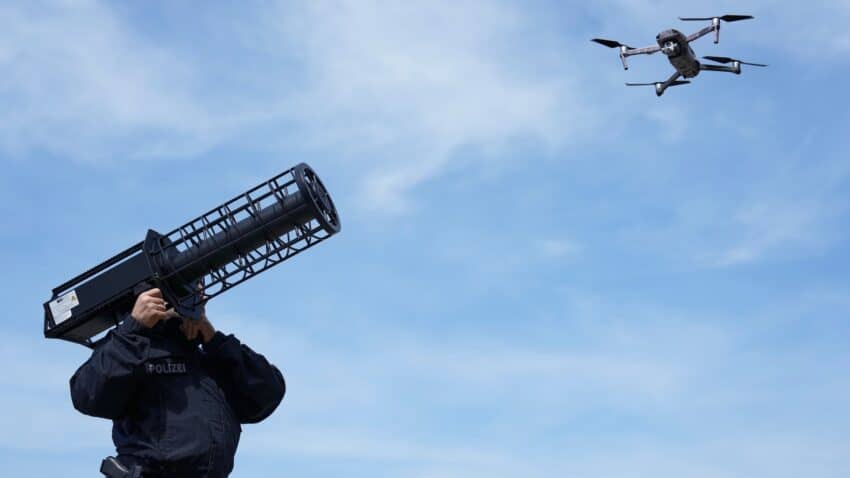
A police officer poses with a "Counter LAV Jammer HP 47 + PR V7" during a demonstration as part of the opening of the drone competence and defense center in Erding, Germany, Monday, May 4, 2026. (AP Photo/Matthias Schrader)

Ghost 4 Airframe Clears Cold-Weather Certification at 4,200 Metres

Certification covered cold starts at minus forty and sustained flight in icing conditions across eleven sorties.

Certification covered cold starts at minus forty and sustained flight in icing conditions across eleven sorties.

Sed ut perspiciatis unde omnis iste natus error sit voluptatem accusantium doloremque laudantium, totam rem aperiam eaque ipsa quae ab illo inventore veritatis et quasi architecto beatae vitae dicta sunt, explicabo.

Neque porro quisquam est, qui dolorem ipsum quia dolor sit amet, consectetur, adipisci velit, sed quia non numquam eius modi tempora incidunt ut labore et dolore magnam aliquam quaerat voluptatem.

News

Counter-UAS Suite Moves to Serial Production After Live-Fire Review

Counter-UAS Suite Moves to Serial Production After Live-Fire Review

The review board cleared the suite for volume manufacture following four live-fire events against low-signature targets.

The review board cleared the suite for volume manufacture following four live-fire events against low-signature targets.

Sed ut perspiciatis unde omnis iste natus error sit voluptatem accusantium doloremque laudantium, totam rem aperiam eaque ipsa quae ab illo inventore veritatis et quasi architecto beatae vitae dicta sunt, explicabo.

Neque porro quisquam est, qui dolorem ipsum quia dolor sit amet, consectetur, adipisci velit, sed quia non numquam eius modi tempora incidunt ut labore et dolore magnam aliquam quaerat voluptatem.

News

Maritime Autonomy Programme Expands to Three Additional Ports

Maritime Autonomy Programme Expands to Three Additional Ports

Hull-mounted sensors and shore relays extend the programme along a further 340 kilometres of coastline.

Hull-mounted sensors and shore relays extend the programme along a further 340 kilometres of coastline.

Sed ut perspiciatis unde omnis iste natus error sit voluptatem accusantium doloremque laudantium, totam rem aperiam eaque ipsa quae ab illo inventore veritatis et quasi architecto beatae vitae dicta sunt, explicabo.

Neque porro quisquam est, qui dolorem ipsum quia dolor sit amet, consectetur, adipisci velit, sed quia non numquam eius modi tempora incidunt ut labore et dolore magnam aliquam quaerat voluptatem.