News

News

GAO: Navy Shipyard Overhaul Could Cost $200B, Take 50 Years
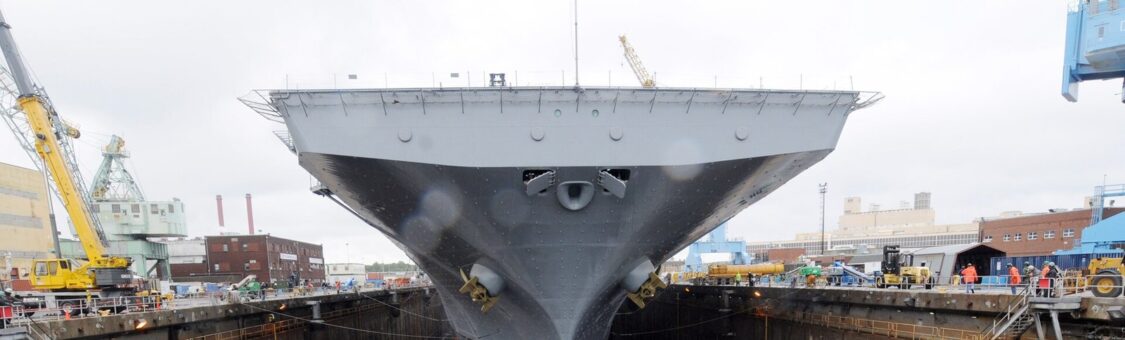
US Navy 090908-N-9774H-023 The amphibious assault ship USS Kearsarge (LHD 3) commenced a dry dock flooding operation at Norfolk Naval Shipyard. Kearsarge is undergoing a 10-month dry docked planned ma Photo: U.S. Navy photo by Mass Communication Specialist 1st Class Emmitt J. Hawks/

GAO: Navy Shipyard Overhaul Could Cost $200B, Take 50 Years

A new government watchdog report says the Navy’s program to overhaul its four public shipyards could cost more than $200 billion and take 50 years to complete, nearly ten times the initial cost estimate and more than double the original timeline.

The Government Accountability Office (GAO) released the report on Sept. 25, 2026, examining the Shipyard Infrastructure Optimization Program (SIOP), which began in 2018. The program aims to upgrade drydocks and standard equipment at the Navy’s four shipyards in Virginia, Maine, Washington, and Hawaii, which handle repairs for the Navy’s nuclear-powered aircraft carriers and submarines.

Initially, the Navy estimated the effort would take about 20 years and cost approximately $21 billion. The GAO report says the project could now take 50 years and cost $200 billion. The report states that the initial estimate “omitted key costs,” and that factors including commodity price increases and seismic concerns at Puget Sound Naval Shipyard requiring “needed retrofits and construction” are driving up costs and adding time to the program.

“Developing the plans and cost estimates to rebuild the Navy’s four public shipyards has taken the Navy years longer — and will cost much more — than originally anticipated due to multiple challenges and changes involved in the program,” the report said.

The GAO also found that more shipyard construction and repair projects have been added to SIOP since 2018, and that the Navy has implemented design changes based on “lessons learned from projects already underway.” For example, the costs for dry-dock projects in Portsmouth and Pearl Harbor grew by more than $2.5 billion since funding was originally requested from Congress.

The GAO noted that the Navy is not required to submit a consolidated report to lawmakers on SIOP program costs and risks, but instead shares updates on “various aspects” of the program. The GAO recommended that Congress require the Navy to provide an annual, standardized report detailing the program’s cost and status.

“Without a full picture of how much has been spent, what remains to be funded, and what risks may affect SIOP progress, Congress could make consequential decisions for SIOP based on incomplete information, thus risking billions in taxpayer dollars and a lack of program oversight for the decades to come,” the GAO report said.

Navy officials previously told Breaking Defense in 2025 that they predict a 10 percent improvement in aircraft carrier maintenance and a 15 percent improvement for submarine maintenance once SIOP is complete. Typically, a submarine maintenance availability lasts 25 to 36 months, but improvements from SIOP would reduce that by approximately three months, officials said.

Meanwhile, President Donald Trump is pushing for a fifth public shipyard to bolster aircraft carrier and submarine readiness.

Sources: DVIDS News · Breaking Defense

News

Police investigate emailed death threat sent to Muslim schools across Canada
Toronto Police Services PD03 police dog cruiser-2.jpg Photo: PvOberstein

Police investigate emailed death threat sent to Muslim schools across Canada

Multiple police forces in Ontario and Quebec have opened investigations into an email sent this week to nine Islamic schools across Canada, threatening to kill Muslims unless they are deported, the Muslim Association of Canada (MAC) said Thursday.

The MAC, which runs the nine private schools that received the email, said it alerted municipal police in Ontario, Vancouver, and Montreal, as well as the Royal Canadian Mounted Police, on Thursday morning. The email was time-stamped Sunday, Sept. 20, and sent from an account titled ‘exposingNWO@protonmail.com’ by a party identifying as ‘Jehu, Citizen Vigilante.’

The message, which CBC News has seen, uses dehumanizing language and states that ‘millions on top of millions of people in the nation of Canada are ready to take up arms.’ It alludes to the upcoming Alberta referendum, which includes a question asking voters to decide if the province should remain a part of Canada or eventually hold a vote on secession, and states Muslims will be ‘deported or slaughtered’ once ‘Alberta becomes its own nation,’ and that this will happen ‘regardless of the election results.’

Police forces in London, Peel Region, Waterloo, and Ottawa confirmed they are investigating. London Police Service said it is investigating a threat to a local school and ‘collaborating with partner law enforcement agencies to gather information and assess any potential connections.’ Potential Criminal Code offences may include uttering threats, criminal harassment, or inciting willful hatred, the service said.

Peel Regional Police said its hate crime unit is actively investigating and that it increased officer presence overnight near local mosques and schools, with patrols to continue over the weekend. Waterloo Regional Police said officers visited a school and conducted safety planning, with its hate crime unit investigating. Ottawa Police Service confirmed it received a complaint and said police visibility remains increased around religious institutions and the affected school.

Montreal’s police service confirmed its hate crime unit is aware of the incident and will lead its investigation.

Nabil Sultan, a MAC spokesperson, said the organization has received ‘hate comments and emails on social media’ before, but a single note targeting many of its schools is unprecedented. He said it was hard not to think of the Afzaal family, four of whose five members were killed in a hate-motivated attack in London, Ont., in June 2021.

‘A part of you wants to move on, and a part of you wants to believe that it was a lone wolf incident, and that something like this should not happen again,’ Sultan said. ‘And this is a reminder that that is not the case, and we’re still under threat.’

Mohammed Saleem, principal of Abraar Elementary School in Ottawa, said getting the note in his inbox was a ‘total shock,’ given the ‘explicitly violent language’ and clear threats to children in the email. He said the school recently temporarily hired security guards after gunmen killed three people during a mosque shooting in San Diego last May, in what police have called a hate-motivated crime.

Statistics Canada reported in March that police-reported hate crimes in Canada more than doubled between 2018 and 2024, from 1,817 to 4,882. Incidents involving Islamophobia nearly tripled, from 84 to 229 over the same period. Reported hate crimes targeting Jews tripled from 331 in 2020 to 920 in 2024.

Saleem said the incident highlights a gap left when the federal government scrapped two offices focusing on combating Islamophobia and antisemitism earlier this year, replacing them with an advisory council meant to combat all forms of hate. ‘It was the wrong move,’ he said.

Sources: CBC Politics

News

DLA awards Metallus up to $995M for 155mm artillery shell steel
TEAD Employee Inspects Artillery Shells on Assembly Line at Tooele Army Depot Photo: Dori Whipple

DLA awards Metallus up to $995M for 155mm artillery shell steel

The Defense Logistics Agency has awarded Ohio steelmaker Metallus a sole-source contract worth up to $995 million for High Fragmentation 1 (HF-1) steel, the alloy used to make bodies of U.S. 155mm artillery shells, the U.S. Department of War announced Sept. 26.

The five-year, firm-fixed-price contract runs through Sept. 24, 2031, and has no option periods. The U.S. Army, U.S. Marine Corps, U.S. Navy, U.S. Air Force and U.S. Space Force are listed as using services. The $995 million figure is a ceiling; the announcement did not say how much steel will be bought or how much will be spent in the first year. Funding will come from fiscal 2025 through 2029 accounts. The Defense Logistics Agency’s contracting office in Columbus, Ohio, is managing the contract.

The agency awarded it without competition under a federal rule that allows sole-source deals to keep a producer available for industrial mobilization or a national emergency.

HF-1 steel is formulated to break into lethal fragments when a shell explodes. It forms the body of the 155mm M795 high-explosive round and the M1128 extended-range round, the main artillery shells fired by U.S. howitzers. An M795 weighs about 47 kg (103 pounds) and carries 10.8 kg (23.8 pounds) of TNT or IMX-101 explosive inside its HF-1 casing.

Metallus, formerly TimkenSteel, is based in Canton and has produced HF-1 steel for the U.S. military continuously since 1993. It normally sells the steel as a subcontractor, supplying billets to companies such as General Dynamics Ordnance and Tactical Systems, which forge them into shell bodies.

The U.S. Army has spent the past two years expanding Metallus’ output as part of its push to build 100,000 155mm shells a month. In February 2024, the Army signed an agreement worth up to $99 million with Metallus, funded by Ukraine supplemental appropriations, to raise HF-1 capacity from 1,500 to 6,720 tons a month. It was the first time Metallus had held a prime contract with the U.S. military.

On Aug. 26, the Army and Metallus commissioned a new bloom reheat furnace, a roller furnace and supporting equipment at the company’s Canton facilities. The Army said that at full capacity the plant will make enough HF-1 steel for more than 120,000 155mm shell bodies a month.

The Army says its ammunition enterprise has opened 16 new facilities over the last two years as part of nearly $6 billion in investments in the defense industrial base.

Sources: DVIDS News · Shephard Media

News

Navy’s W93 submarine-launched warhead enters full-scale development
US Navy 110301-N-7237C-009 An unarmed Trident II D5 missile launches from the Ohio-class fleet ballistic-missile submarine USS Nevada (SSBN 733).jpg Photo: U.S. Navy photo by Seaman Benjamin Crossley

Navy’s W93 submarine-launched warhead enters full-scale development

The U.S. Navy’s new submarine-launched nuclear warhead, the W93, has moved into full-scale development after passing Milestone B this year, marking the first new U.S. nuclear warhead and reentry body program started in nearly 40 years, the Navy’s Strategic Systems Programs office announced.

The W93 and its Mk7 reentry body—the cone-shaped shell that carries the warhead back through the atmosphere—have entered engineering and manufacturing development, the phase where engineers finalize the production design and prove the weapon can be built in the numbers the Navy needs. The office did not specify when the milestone was reached or give a date for first production.

“W93/Mk7 will provide flexibility and adaptability to meet future Warfighter needs and ensure an uninterrupted at sea deterrent for the sea-based leg of the nuclear triad,” said Vice Adm. Douglas Williams, director of Strategic Systems Programs. “We were able to accelerate our entry into this next phase because of the dedicated partnership between PAE SSP, National Nuclear Security Administration, and our industry base. This is what working at hyper-speed looks like.”

The Navy runs the program with the National Nuclear Security Administration (NNSA) and its national laboratories. Los Alamos National Laboratory in New Mexico is designing the warhead.

“Credible deterrence demands that we move with urgency, and the progress we’re making on W93/Mk7 demonstrates exactly that,” said Brandon Williams, administrator of the NNSA.

The W93 will arm the Trident II D5 ballistic missiles carried by U.S. Navy ballistic missile submarines. Those missiles currently carry two warheads: the W76, in service since 1978, and the W88, which entered the stockpile in 1988. The W76 rides in the Mk4 reentry body and the W88 in the Mk5.

Los Alamos said the W93 design uses nuclear components that were tested before the United States stopped explosive nuclear testing, updated with modern materials. The lab said the warhead is expected to go aboard Ohio-class submarines, likely starting in the mid-2030s, and later move to the new Columbia-class submarines as they replace the Ohio class.

The program completed its feasibility and design options phase in March 2025, according to Los Alamos, producing draft military requirements and a description of the conditions the weapon must survive from storage to detonation.

Britain is tied to the program through the Mk7. The United Kingdom will use the same reentry body for its own new warhead, the A21, known as Astraea. The British Ministry of Defence says Astraea is a sovereign design developed in parallel with the W93 and will arm the Royal Navy’s future Dreadnought-class submarines.

Strategic Systems Programs also maintains the Trident missile system on the Ohio-class boats and is integrating a life-extended version of the D5 on the Columbia class. The office is developing a follow-on missile, the D5LE2, as well as a nuclear-armed sea-launched cruise missile known as SLCM-N and the non-nuclear Conventional Prompt Strike hypersonic weapon.

Sources: DVIDS News · DVIDS News

News

Navy Establishes New Center to Integrate Robotic, Autonomous Systems Into Fleet Operations
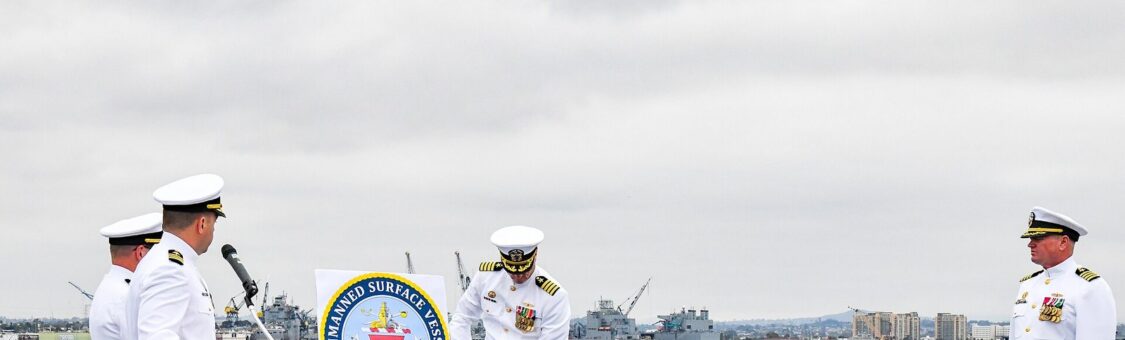
Standup Ceremony held for Unmanned Surface Vessel Squadron 3 240517-N-UN585-1006.jpg Photo: Mass Communication Specialist 1st Class Claire M. DuBois, U.S. Navy

Navy Establishes New Center to Integrate Robotic, Autonomous Systems Into Fleet Operations

The U.S. Navy formally established the Robotic and Autonomous Systems Warfighting Development Center (RASWDC) on Thursday at Joint Expeditionary Base Little Creek-Fort Story in Virginia, creating a dedicated organization to accelerate the integration of robotic and autonomous systems into fleet operations.

The center, announced by Secretary of the Navy and Chief of Naval Operations Adm. Daryl Caudle, is an Echelon 3 warfighting development center operating under U.S. Fleet Forces Command. It will serve as the Navy’s Fleet-facing operational integration point for robotic and autonomous capabilities, according to a Navy press release.

Rear Adm. Melvin Smith has been designated as the inaugural commander of RASWDC. He is leading a phased near-, mid-, and long-term implementation plan that includes developing the command structure, mission relationships, and resource requirements as the organization progresses toward full operational capability.

“To maintain our decisive maritime advantage, we must rapidly integrate robotic and autonomous systems into how we operate, train, and deploy,” Caudle said in a statement. “The establishment of RASWDC ensures our Sailors are equipped with the tactical edge, advanced training, and specialized doctrine required to win the high-end fight.”

RASWDC operates alongside the recently announced Direct Reporting Portfolio Manager for Robotic and Autonomous Systems (DRPM RAS). While DRPM RAS handles acquisition, requirements, budgeting, technical standards, and fielding, RASWDC focuses entirely on operational employment. Together, the organizations create a feedback loop between the acquisition enterprise and operational forces, with RASWDC returning empirical performance data to developers and program managers.

The center has three core missions, according to Caudle: develop warfighting concepts, train sailors, and field and test new technology. It will test uncrewed platforms in realistic operational conditions, including environments with degraded or denied communications.

“Systems that work will move forward. Systems that do not will be improved, redirected, or stopped,” Caudle wrote in an administrative message. “The measure of success is not how many prototypes we demonstrate. It’s how much combat power we can repeatedly generate, deploy, sustain, and adapt.”

“A prototype is not combat power,” Caudle said. “Combat power comes when a trained sailor can employ a reliable system, supported by the right networks, logistics, maintenance, software, tactics, authorities, and command relationships, to create an operational effect.”

Smith said the center will consolidate the Navy’s autonomous efforts across air, surface, and undersea domains. “Our mandate is straightforward: educate our warfighters, equip the Fleet with tools that actually survive the environment, and develop the combined tactics to employ them decisively,” he said. “We are here to make sure our forces don’t just field unmanned systems, but dominate with them.”

RASWDC will not replace existing warfighting development centers, type commanders, systems commands, or operational commands, but will coordinate with them to incorporate emerging requirements and share lessons learned.

The establishment follows Caudle’s earlier unveiling of a “Hedge Strategy” that includes a major role for uncrewed systems, and a Sept. 2 C-NOte calling for swift integration of lasers into the fleet. The center will develop doctrine, tactics, techniques, and procedures, as well as an advanced tactical instruction framework to certify and deploy the platforms.

Sources: DVIDS News · DefenseScoop

News

Polish Defense Official Says US Has Decided to Establish a Base in Poland
1-62 Air Defense Artillery Battalion extends deployment in Poland (8259953).jpg Photo: U.S. Army 10AAMDC by Capt. Leara Shumate

Polish Defense Official Says US Has Decided to Establish a Base in Poland

Poland’s defense minister said Sept. 25 that the United States has decided to establish a permanent military base in Poland, a longtime goal of the Polish government, though the Pentagon has not confirmed the decision.

According to Defense One, the Polish official’s statement, made during a public appearance, marks a potential shift in US force posture in Europe. The report did not specify the location, size, or cost of the proposed base, nor did it provide a timeline for its establishment.

The Pentagon has not issued a statement confirming or denying the Polish official’s claim. The lack of official US confirmation leaves the story developing, and the details of any agreement remain unclear.

Poland has long sought a permanent US military presence on its territory, viewing it as a deterrent against Russian aggression. The reported decision, if confirmed, would represent a significant change in the US military’s rotational presence in the region.

The Defense One report, published Sept. 25, 2026, is based on the Polish official’s remarks. No US military or government sources have commented on the matter.

Sources: DVIDS News · DVIDS News

News

New Video Shows Blackbeard Hypersonic Missile on Super Hornet in Flight
An F-A-18F Super Hornet approaches USS Gerald R. Ford. (35935346800).jpg Photo: Official U.S. Navy Page from United States of America Erik Hildebrandt/U.S. Navy

New Video Shows Blackbeard Hypersonic Missile on Super Hornet in Flight

The U.S. Navy has released new video footage showing the Blackbeard hypersonic strike missile mounted under the wing of an F/A-18E/F Super Hornet during flight testing, offering the clearest look yet at the weapon the service aims to field by 2028. The footage, released by Naval Air Systems Command (NAVAIR), shows two Blackbeard missiles installed under the fighter’s wing, according to The War Zone and The Aviationist.

Blackbeard is being developed by California-based defense start-up Castelion under the Navy’s Multi-mission Affordable Capacity Effector (MACE) program, which seeks a relatively low-cost, long-range strike weapon that can be produced in large numbers. The Navy describes Blackbeard as a “responsive, long-range, high-speed strike option” for carrier-based aircraft, according to The Aviationist.

The new imagery comes after the Navy confirmed in August 2026 that it had begun test-loading the missiles onto Super Hornets, as shown in a presentation at the Tailhook Association’s annual convention. The new footage shows the program has advanced to actual flight testing, The War Zone reported.

Blackbeard has moved rapidly through acquisition. Key contract awards include:

  • February 2026: $49.9 million to advance the missile from prototype toward Early Operational Capability, with work scheduled through November 2027.
  • April 2026: $105 million for F/A-18 integration, including hardware and software integration, flight testing, system-safety work, and airworthiness certification for carrier operations.
  • June 2026: $23.4 million firm-fixed-price order for 50 Early Operational Capability pre-production prototypes and 50 shipping and storage containers.
  • Aug. 25, 2026: $89.997 million award to support the 50 EOC weapons and transition toward a formal Program of Record, including Defense Exportability Features.
  • Sept. 14, 2026: A production delivery order worth up to $200 million, with an initial $43.65 million order covering 444 All-Up Rounds—fully functional tactical missiles in shipping containers.

Work under the September award will be performed at Castelion’s 1,000-acre manufacturing campus in Rio Rancho, New Mexico, and at its facility in Torrance, California, The Aviationist reported.

Detailed performance figures for Blackbeard remain classified, but the weapon is described as hypersonic, meaning it is designed to exceed Mach 5. Castelion has previously hinted it could hit targets out to just under 500 miles, The War Zone reported. The missile’s design includes a booster stage with a possible unpowered hypersonic glide vehicle on top, though the second stage may have its own motor.

The Navy is pursuing Blackbeard as a relatively cheap, rapidly producible standoff weapon, with the goal of reaching at least limited service no later than 2028. The F/A-18E/F Super Hornet is set to be the first operational launch platform, and the U.S. Army is pursuing a ground-launched version of the missile, The War Zone reported.

Sources: DVIDS News · Breaking Defense

News

Navy shipyard overhaul could top $200B, GAO says
Stern view of USS Nimitz (CVN-68) in Dry Dock No. 6 of the Puget Sound Naval Shipyard, 5 March 2018 (180305-N-CC918-007).JPG Photo: U.S. Navy Puget Sound Naval Shipyard and Intermediate Maintenance Facility (PSNS & IMF) photo by Thiep Van Nguyen

Navy shipyard overhaul could top $200B, GAO says

The U.S. Navy’s Shipyard Infrastructure Optimization Program (SIOP) could cost more than $200 billion and take more than 50 years to complete, according to a Government Accountability Office (GAO) report released Friday. The figure is nearly ten times the program’s original estimate of about $21 billion and a 20-year timeline, which the Navy set when SIOP launched in 2018.

The GAO report said the initial estimate “omitted key costs” and that factors including commodity price increases and seismic concerns at Puget Sound Naval Shipyard requiring “needed retrofits and construction” are driving up costs and adding time. More shipyard construction and repair projects have been added to SIOP since 2018, and the Navy has implemented design changes stemming from “lessons learned from projects already underway,” the report said.

As an example, the report cited dry-dock projects at Portsmouth Naval Shipyard in Kittery, Maine, and Pearl Harbor, Hawaii, whose combined costs grew by more than $2.5 billion since funding was originally requested from Congress.

The program aims to upgrade drydocks and standard equipment at the Navy’s four public shipyards in Virginia, Maine, Washington, and Hawaii, which handle repairs for the Navy’s nuclear-powered aircraft carrier and submarine fleet. The GAO noted that the Navy is not mandated to submit a consolidated report to lawmakers on SIOP program costs and risks, instead sharing updates on “various aspects” of the program.

The GAO recommended that Congress require the Navy to share an annual, standardized report detailing the program’s cost and status. “Without a full picture of how much has been spent, what remains to be funded, and what risks may affect SIOP progress, Congress could make consequential decisions for SIOP based on incomplete information, thus risking billions in taxpayer dollars and a lack of program oversight for the decades to come,” the report said.

Navy officials previously told Breaking Defense in 2025 that they predict a 10 percent improvement in aircraft carrier maintenance and a 15 percent improvement for submarine maintenance once SIOP is complete. They said a typical submarine maintenance availability lasts 25 to 36 months, and SIOP improvements would reduce that by approximately three months. President Donald Trump is pushing for a fifth public shipyard to bolster aircraft carrier and submarine readiness.

Sources: Navy Times · DVIDS News

News

Navy’s $200B shipyard overhaul lacks oversight, watchdog finds
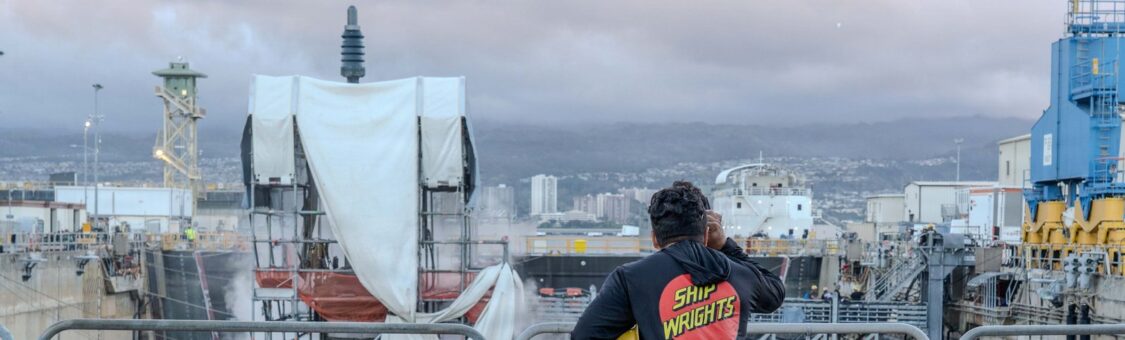
USS Illinois successfully undocks at Pearl Harbor Naval Shipyard Photo: Kenny Jones

Navy’s $200B shipyard overhaul lacks oversight, watchdog finds

The U.S. Navy’s Shipyard Infrastructure Optimization Program will exceed $200 billion and take more than 50 years to execute, but the program is not regularly evaluated for its costs, risks and performance, according to a new Government Accountability Office report published Sept. 25.

The lack of oversight could lead to Congress making consequential decisions “based on incomplete information, thus risking billions in taxpayer dollars,” the GAO wrote in its report.

The findings come as the Navy undertakes a generational effort to improve poor conditions and outdated infrastructure at the shipyards in Norfolk, Virginia; Pearl Harbor, Hawaii; Portsmouth Naval Shipyard in Kittery, Maine; and Puget Sound, Washington. The four public shipyards are the focus of the multi-billion-dollar modernization program.

The GAO report did not specify which Navy officials are responsible for the missing evaluations or when the next program review is scheduled.

Capt. Hannah A. Kriewaldt relinquished command of Supervisor of Shipbuilding, Conversion and Repair (SUPSHIP) Newport News on Sept. 18, handing over to Capt. Michael A. Sammataro in a combined change of command and retirement ceremony at Newport News, Virginia.

Kriewaldt led the command of more than 600 Navy civilian and military personnel, overseeing multi-billion-dollar shipbuilding programs including Gerald R. Ford-class aircraft carriers, Columbia-class ballistic missile submarines, and Virginia-class attack submarines. The command is the Navy’s on-site technical, contractual and quality authority at Huntington Ingalls Industries–Newport News Shipbuilding, the sole U.S. facility capable of building nuclear-powered aircraft carriers.

During the ceremony, Rear Adm. Casey Moton presented Kriewaldt with her second Legion of Merit award. Rear Adm. Dianna Wolfson delivered the retirement address.

Kriewaldt, a 1999 Naval Academy graduate, served as chief engineer aboard USS Abraham Lincoln (CVN 72) earlier in her 27-year career.

Sources: DVIDS News · DVIDS News

News

Chinese Warships, Cutters Block Philippine Resupply Mission to Second Thomas Shoal
USS Canberra participates in group sail during JCA in Philippines Photo: Navy

Chinese Warships, Cutters Block Philippine Resupply Mission to Second Thomas Shoal

Chinese warships and coast guard cutters blocked a Philippine resupply mission to Second Thomas Shoal on Thursday, according to Manila’s National Task Force for the West Philippine Sea, which announced the incident on Friday. The mission was temporarily suspended after “dangerous maneuvers” by Chinese forces threatened a collision with the Philippine Navy-operated resupply ship Lapu Lapu, the Philippine maritime security agency said.

Two Philippine Coast Guard patrol vessels, BRP Malabrigo (MRRV-4402) and BRP Cabra (MRRV-4409), were supporting the resupply ship when Chinese forces intercepted the mission about 60 nautical miles from Second Thomas Shoal. The task force said Chinese forces “put Filipino personnel at risk and obstructed a legitimate humanitarian and sustainment operation.”

A Philippine Coast Guard graphic shows three Chinese cutters shadowing Cabra and Lapu Lapu. An additional force of 11 China Coast Guard and China Maritime Militia vessels was observed near the grounded World War II-era landing ship BRP Sierra Madre (LT-57) at Second Thomas and Sabina Shoals. The Armed Forces of the Philippines told ABS-CBN News that the People’s Liberation Army Navy deployed three warships, including two Type 022-class missile boats, to support the interception.

The encounter is the first publicly reported instance of China blocking a resupply mission since Manila and Beijing inked a provisional agreement in 2024 that enabled Philippine forces to access Second Thomas Shoal without harassment. The terms of that deal, put into practice in July 2024, are not publicly available. Chinese state media outlet Global Times reported that this week’s incident occurred because the Philippines did not get approval from Beijing to sail to the shoal. Manila has repeatedly denied that the agreement requires Chinese approval for access.

The waters around Sierra Madre have been tense in recent months. Philippine and Chinese sailors engaged in a melee with batons and oars in July, and armed Chinese small boats swarmed Second Thomas Shoal last year after a fatal incident at Scarborough Shoal. This week’s resupply mission coincided with a Philippine-led multinational maritime drill near Scarborough Shoal on Wednesday involving Association of Southeast Asian Nation member states and partners including the U.S., Australia, India and Japan.

Sources: DVIDS News · Defence Blog