News

News

UN experts find ‘reasonable grounds’ US strike on Iran school was a war crime
CENTCOM 12 January 2024-1.jpg Photo: U.S. Air Force photo

UN experts find ‘reasonable grounds’ US strike on Iran school was a war crime

UN experts have found “reasonable grounds” to believe that a US strike on an Iranian school amounts to a war crime, according to a video report published by Military.com on Sept. 22, 2026. The report, which cites the UN finding, did not provide a specific date for the strike, the number of casualties, or the exact location of the school.

The finding was reported in a video segment on Military.com’s website.

In a separate development, Defense News reported on Sept. 22, 2026, that South Korea is facing a dilemma over whether to contribute forces to US operations in the Strait of Hormuz amid the ongoing war with Iran. The report cited experts who said Seoul faces a “military capacity dilemma” as it weighs requests from Washington against escalating threats from North Korea.

According to Defense News, the South Korean Army reported that North Korea had fired two ballistic missiles on Sunday and earlier this month launched a 5,000-ton guided missile destroyer in the Pacific. President Lee Jae Myeong has said there would be “no deployment to a war,” but the government may instead extend the activities of the Cheonghae Unit, a naval task force group stationed in the Sea of Aden for counter-piracy operations.

The Cheonghae Unit includes a KDX-II destroyer, a maritime helicopter, Marines, naval special forces and support personnel. Esmaeil Baqaei, spokesperson for Iran’s Foreign Ministry, warned on Sept. 7 that any foreign military involvement in the strait could face serious consequences. Iranian academic Mohammad Marandi said Tehran could regard South Korea as an enemy and target Korean economic and military assets across the Persian Gulf if Seoul joined a US-led effort to secure the Strait of Hormuz.

South Korea has committed a $20 billion investment in an energy project in Texas, which Ju Hyung Kim, president of Security Management Institute, said may help appease Washington for now. However, Kim said the larger challenge is the precedent it might create, as President Donald Trump might expect additional contributions as the conflict continues.

Kim said force allocation will become a graver concern if alliance commitments take South Korean assets far from the peninsula for a prolonged period. “A P-8A deployed to the Gulf, for example, cannot simultaneously perform maritime-surveillance or anti-submarine missions around the Korean Peninsula,” he said. “So the key question is not simply whether the Cheonghae Unit is sufficient now, but whether it becomes the beginning of recurring U.S. expectations for South Korean deployments beyond Northeast Asia.”

Sources: Defense News · Military.com

News

Pentagon investigating F-35 parts diverted to Hong Kong; Australia says components not ‘sensitive’
F-35 Wind Tunnel Model.jpg Photo: U.S. Air Force photo/David Housch

Pentagon investigating F-35 parts diverted to Hong Kong; Australia says components not ‘sensitive’

The Pentagon is investigating how a shipment of unserviceable F-35 Lightning II components was diverted from Australia to Hong Kong, with at least one part — a cockpit canopy coated in radar-absorbing material — still missing, according to statements from the F-35 Joint Program Office and reporting by Politico, first published Sept. 18, 2026.

The components were being transported by an intermediary company for Lockheed Martin, bound for the U.S. for repair or disposal, when the cargo was sent to Hong Kong instead, according to Politico, which cited anonymous sources. The Pentagon has said it is not clear why the parts were sent to Hong Kong or who currently has them.

In a statement, the F-35 Joint Program Office said officials “are aware of a shipment issue of unserviceable F-35 Lightning II components” and are “actively working with U.S. authorities and industry partners to retrieve these components, investigate the incident, and place safeguards to avoid a future occurrence.”

Lockheed Martin said in a statement that the company “continues to work closely with the U.S. Government following this incident and we have complied fully with all laws, policies, and export‑control regulations.” The company described the missing components as “unserviceable and deemed low risk for exploitation.”

Australian Deputy Prime Minister and Defence Minister Richard Marles said on Sept. 22 that Canberra is working with Washington and Lockheed Martin on the issue. “We are examining very much everything that has occurred at the Australian end,” Marles said, according to a government transcript. He said his “understanding” is that “we’re not talking about sensitive parts here,” while referring questions about the nature of the components to the U.S. government and Lockheed.

Politico reported that the shipment included one of the F-35’s canopies, which incorporates radar-absorbent material that helps mitigate the aircraft’s radar signature. The canopy was still missing as of the reporting.

The incident prompted briefings in June for congressional staff on key national security committees, according to Politico. The parts may have originated from the F-35 Aircraft Sustainment Hub at Williamtown in New South Wales, which manages spare parts for the Asia-Pacific region, according to The Aviationist.

Australia operates 72 F-35A aircraft. The F-35 program has 20 global customers, and the State Department recently cleared a $24 billion F-35 sale for Saudi Arabia, according to Breaking Defense.

A 2023 Government Accountability Office report found that over 1 million F-35 parts collectively valued at $85 million were unaccounted for, warning that number could be much higher, Breaking Defense reported.

Sources: Breaking Defense · Defense One

News

Sentinel ICBM completes vertical stacking ahead of 2027 flight test
583rd Missile Maintenance Squadron refurbishes Minot AFB missile suspension system Photo: SrA Carson Jeney

Sentinel ICBM completes vertical stacking ahead of 2027 flight test

The Sentinel intercontinental ballistic missile program has completed vertical stacking of an inert missile, a major milestone ahead of its planned 2027 initial flight test, the Air Force announced.

The stacking, which took place at an undisclosed location, involved assembling the missile’s stages vertically for the first time, validating the design and ground handling procedures. The Air Force said the milestone clears the way for the first flight test of the LGM-35A Sentinel, scheduled for 2027, as part of the service’s nuclear modernization effort.

The Sentinel program, managed by the Air Force Nuclear Weapons Center, is intended to replace the aging Minuteman III ICBM fleet.

The vertical stacking of the inert missile is a key step before the first test flight, which will use a live missile. The Air Force said the test will validate the missile’s performance and support the program’s transition to production.

“This is a significant achievement for the Sentinel team and a critical step toward delivering this capability to the warfighter,” said a program official, speaking on condition of anonymity.

Sources: Air Force Times · DVIDS News

News

US, UK Test-Launch Mk 48 Torpedo from Royal Navy Unmanned Submarine
US Navy 110520-N-VQ827-880 The Royal Navy Trafalgar-class submarine HMS Torbay (S90) is underway in formation with the George H.W. Bush Carrier Str.jpg Photo: U.S. Navy photo by Mass Communication Specialist 3rd Class Nicholas Hall

US, UK Test-Launch Mk 48 Torpedo from Royal Navy Unmanned Submarine

The Royal Navy successfully launched a U.S. Navy Mk 48 Heavyweight Torpedo from a British Excalibur uncrewed underwater vehicle (UUV) on Sept. 13 at the British Underwater Test & Evaluation Centre in Scotland, according to a U.S. Navy press release reported by Defense News and Navy Times.

The test marks a significant step for AUKUS Pillar 2, the trilateral agreement between the U.S., U.K., and Australia aimed at enabling UUV payload systems that can be used across each country’s vehicles, as outlined in a May 2026 agreement.

While described as a proof of concept, the test “validated the mechanical, electrical, and software integration of a U.S. kinetic payload onto an allied autonomous vessel, proving that allied forces can rapidly achieve weapon interchangeability,” the Navy press release stated.

Adm. Daryl Caudle, Chief of Naval Operations, called the cooperation “a historic first for allied undersea warfare.” He added: “Proving that we can seamlessly launch a U.S. heavyweight torpedo from a Royal Navy autonomous underwater vehicle validates our shared vision for true interchangeability. By integrating weapons, payloads, and mission architectures across allied platforms, we are increasing the flexibility, scale, and combat power of our combined forces and ensuring they are ready to meet the strategic demands of tomorrow.”

The Mk 48 is the U.S. Navy’s standard heavyweight torpedo, measuring 19 feet long with a 21-inch diameter. The latest version, the MOD 7, was developed under a Joint Development Program with the Royal Australian Navy and is optimized for “traditional and emerging missions,” according to the Navy.

The Excalibur, unveiled in May 2025, is the Royal Navy’s first uncrewed submarine. Video of the event shows the torpedo was placed under the nearly 40-foot submersible and launched from a cradle attached to the hull.

According to the U.K. publication Navy Lookout, “Excalibur has no torpedo tubes, but a large central payload bay with doors at the top and bottom. However, the Mk 48 torpedo… is too long to fit in the standard central payload bay.”

The successful deployment is just the first step under AUKUS Pillar 2, according to the sources.

Sources: Defense News · Navy Times

News

FBI Bribery Probe Into Defense Contractor Navatek Shut Down Under Trump, Sources Say
10th Special Forces Group Soldiers (Airborne) receive FBI’s Director’s Award Photo: Michael Bottoms

FBI Bribery Probe Into Defense Contractor Navatek Shut Down Under Trump, Sources Say

The FBI has shut down a corruption probe into a Hawaiian defense contractor accused of bribing U.S. lawmakers for Pentagon contracts, according to a ProPublica investigation published Sept. 22, 2026. The contractor, Navatek, allegedly sought to trade campaign donations for federal funding, and its former CEO told FBI agents that the scheme involved dozens of politicians.

According to the report, Navatek CEO Martin Kao met in late 2019 with Scott Reed, head of a super PAC supporting Sen. Susan Collins (R-Maine), at a Corner Bakery in Washington, D.C. Reed asked the Navatek executives for a $500,000 donation, and Kao told Reed that if they cut a big check, Navatek wanted Collins to guarantee tens of millions of dollars in additional federal funding. Navatek planned to funnel the donation through a shell company to skirt campaign finance laws and conceal the source of the funds, and Kao wanted assurance Collins would know where the money came from, the report said.

Kao sent an initial $150,000 to the Collins super PAC using the shell company after the meeting, the report states. Two months later, he told Navatek executives that Collins had committed to getting the company $32 million in naval contracts, according to an internal company email reviewed by ProPublica.

In 2022, a grand jury indicted Kao for making illegal campaign contributions. No one working for Collins was charged. Facing prison time, Kao began cooperating with the FBI, giving agents a 50-page document naming dozens of lobbyists, congressional staffers and members of Congress he said helped him trade cash for contracts, the report said. Kao and his close associates had donated nearly $900,000 to dozens of politicians, allowing Navatek to establish operations in half a dozen states with over $40 million a year in government funding.

Kao’s interviews with the FBI lasted into late 2024. By the end of that year, agents had enough evidence to pursue a sweeping bribery probe that could ensnare top lawmakers of both parties, and they asked supervisors to approve a new investigation, the report said. Agents sifted through hundreds of thousands of records seized during Kao’s arrest and found many consistent with his account.

Then Trump returned to the White House, according to the report. The specialized FBI and DOJ teams handling public corruption investigations were eviscerated, one agent who took Kao’s confession was pushed out, and dozens of agents and prosecutors quit, including the career attorney assigned to Kao’s case. The investigation sparked by Kao’s revelations is dead, and the government is no longer talking to the informant, the report said.

FBI spokesperson Ben Williamson said the agency investigated claims against Collins years ago “and ultimately found nothing implicating Senator Collins or Senator Collins’ campaign. Any suggestion otherwise is totally false.” Williamson said the Trump administration removed agents only “if they have been found to have acted unethically, undermined the mission, or engaged in weaponization of law enforcement.” He did not respond to questions about the new investigation launched in 2024.

Annie Clark, Collins’ deputy chief of staff, said Collins’ office “vigorously” denies allegations of bribery and pay-for-play made by Kao, calling his claims “outlandish.” Clark said the office “fully cooperated” with the FBI investigation.

“The fact that the FBI and Biden-led Department of Justice thoroughly examined” the allegations and found no wrongdoing, Clark said, shows the claims lack merit.

ProPublica said it reviewed a trove of evidence gathered by the FBI and thousands of pages of legal records, and independently corroborated much of Kao’s account. The report is the first in a series of stories drawn from its reporting.

Sources: Defense One

News

F-35 spare parts diverted to Hong Kong from Australia, prompting U.S., Australian investigations
Passing the Torch: a commander’s final flight crosses paths with student pilot’s first in the F-35 Photo: SSgt Magen Reeves

F-35 spare parts diverted to Hong Kong from Australia, prompting U.S., Australian investigations

Australian Defence Minister Richard Marles said Sept. 22 that Canberra is working with Washington and Lockheed Martin to investigate a shipment of F-35 spare parts that was diverted from Australia to Hong Kong, but said he does not believe the parts are “sensitive.”

POLITICO first reported Sept. 18 that a collection of F-35 parts handled by a Lockheed “intermediary” bound for the U.S. for repairs was diverted after leaving Australia and wound up in Hong Kong. The shipment included one of the F-35’s canopies, coated in radar-absorbing material, which was still missing, according to the outlet.

“We are examining very much everything that has occurred at the Australian end, but the point I would make here is that we are confident about the way in which we’ve engaged with the program, and through the US’s prime contractor, Lockheed,” Marles said, according to a government transcript. He said his “understanding” is “we’re not talking about sensitive parts here.”

The Pentagon’s F-35 Joint Program Office said officials “are aware of a shipment issue of unserviceable F-35 Lightning II components. We are actively working with U.S. authorities and industry partners to retrieve these components, investigate the incident, and place safeguards to avoid a future occurrence.”

A Lockheed spokesperson said the company “continues to work closely with the U.S. Government following this incident and we have complied fully with all laws, policies, and export‑control regulations.” The spokesperson added that the missing components “are unserviceable and deemed low risk for exploitation.”

The parts may have been sent from the F-35 Aircraft Sustainment Hub at Williamtown in New South Wales, which controls the transfer of spare parts for the F-35 across the Asia-Pacific region and was originally set up by BAE Systems, according to The Aviationist. The identity of the contractor responsible for transporting the components has not been publicly disclosed.

Australia operates 72 F-35A aircraft.

The incident follows a 2023 Government Accountability Office report that found over 1 million F-35 parts collectively valued at $85 million were unaccounted for, warning that number could be much higher.

Sources: Defense News · Breaking Defense

News

Air Force says China Aerospace Studies Institute will continue, despite civilian cuts
30th Intelligence Squadron airmen at DGS-1.png Photo: Air Force Reserve Command Public Affairs

Air Force says China Aerospace Studies Institute will continue, despite civilian cuts

The Air Force is eliminating civilian staff roles for the China Aerospace Studies Institute (CASI) but will keep the research entity running, according to a service spokesperson.

In a statement to Breaking Defense on Sept. 22, the spokesperson said that in response to “an ongoing civilian restructure within” the Air Force’s Air Education and Training Command, civilian staff “will no longer be assigned to China Aerospace Studies Institute (CASI).” The spokesperson added that CASI’s “mission continues” and will be executed by “leveraging assigned military service members to accomplish its objectives.”

Affected civilian employees “will continue in their current positions until further notice and will be evaluated for reassignment,” the spokesperson said.

CASI is a government-run think tank that regularly publishes research on Beijing’s air and space forces. The entity shares its findings within the US military and the broader defense community to promote understanding of China’s military prowess, with the goal of shaping policy and strategy.

The organization’s most recent work was published Monday. The paper, entitled From Vision to Vigilance: How Beijing’s Space-Science Roadmap Builds a Real-Time Kill Webb, explores how technologies ostensibly geared toward space exploration could instead “support persistent, multi-spectral coverage across the Pacific with near-real time refresh,” the paper’s introduction reads. Those technologies could then be used for military purposes to aid what defense officials call a “kill web,” essentially a network of integrated sensors that can provide multiple ways to track and strike a target.

Trouble at CASI first surfaced Monday when a civilian staffer posted online about their role being eliminated, including that the Air Force planned to “shutter” the institute. The move, coming the week that Chinese President Xi Jinping is slated to visit the United States, prompted questions about similar study projects run by the Army and Navy.

The Naval War College told Breaking Defense that “[t]here are no anticipated changes to manning or capacity at the China Maritime Studies Institute at the U.S. Naval War College.” Army University did not respond to a request for comment about the status of the China Landpower Studies Center, which is run by the US Army War College.

The reduction at CASI mirrors moves championed last year during the height of the Department of Government Efficiency effort, where an analysis by Breaking Defense and the American Enterprise Institute found tens of thousands of civilian positions were axed across the Defense Department.

Sources: Breaking Defense

News

USS Georgia returns to Kings Bay for final time, begins inactivation
US Navy 090831-N-8467N-003 The Los Angeles class submarine USS Helena (SSN 725) gets underway from Submarine Base New London.jpg Photo: U.S. Navy Photo by John Narewski

USS Georgia returns to Kings Bay for final time, begins inactivation

The Ohio-class guided-missile submarine USS Georgia (SSGN 729) returned to her homeport of Naval Submarine Base Kings Bay, Georgia, on July 27, 2026, for the final time, beginning the inactivation process that will make her the first Ohio-class guided-missile submarine to leave the fleet.

The Georgia was commissioned on Feb. 11, 1984, as an Ohio-class ballistic missile submarine designed for Cold War nuclear deterrence. She was later redesignated as a guided-missile submarine on March 1, 2004, swapping nuclear missiles for a conventional arsenal of up to 154 Tomahawk cruise missiles and dedicated lockout chambers to support special operations forces such as Navy SEALs.

Senior Chief Machinist’s Mate Auxiliary John Edwards made the final surfacing announcement aboard the submarine as she returned to port. Edwards, who spent nearly seven years aboard the boat and more than half of his Navy career on her, described the moment’s emotional weight.

“There were tears in the room; just the thought of this being the last time ever that this would happen,” Edwards said.

Following the final return, the Georgia’s ballast tanks will remain dry and she will not dive again.

Lt. Cmdr. Dennis Mauldwin, the ship’s engineer officer, was responsible for bringing the submarine up from the deep for the final time. His 13-year-old daughter was aboard for a Tiger Cruise, a program allowing family members to sail with their Navy sponsors, giving her the chance to see her father perform his job.

“Here’s my daughter on board the submarine while I’m standing watch and giving orders, but she’s right there when I turn and look at her. That’s going to be something that she and I share forever,” Mauldwin said.

The submarine routinely carries about 175 to 185 sailors, a number that increases when special operations forces come aboard. Culinary Specialist (Submarine) 1st Class Aaron Sarver said a planned 120-day food loadout often had to be stretched to support a 180-day requirement when additional personnel boarded.

As the Georgia moves into her decommissioning phase, the Navy’s dual-crew model of Blue and Gold crews is being combined into a single crew. Those in charge of the decommissioning efforts are creating a road map for the inactivation processes of the Ohio-class guided-missile submarines that follow.

Sources: DVIDS News · DVIDS News

News

U.S., U.K. Test Fire Torpedo From Uncrewed Submarine in First
US Navy 080808-N-7668G-123 Conventional weapons handling team member Sonar Technician (Submarines) Seaman Apprentice Neil McGuire, from Athol, Mass., shuts the breech door of the torpedo tube of the f Photo: U.S. Navy photo by Electrician's Mate 2nd Class Xander Gamble

U.S., U.K. Test Fire Torpedo From Uncrewed Submarine in First

The U.S. Navy and Royal Navy successfully launched a U.S. Mk 48 Heavyweight Torpedo from a British Excalibur uncrewed underwater vehicle (UUV) on Sept. 13 at the British Underwater Test & Evaluation Centre in Scotland, marking a first-of-its-kind test for both countries.

The proof-of-concept launch, announced Sept. 22, was conducted under AUKUS Pillar 2, the trilateral agreement between the U.S., U.K., and Australia to enable UUV payload systems usable across each country’s vehicles, according to a May 2026 agreement. Personnel from the Pentagon’s Defense Innovation Unit and the Naval Undersea Warfare Center Keyport Division, along with industry partners, took part in the test.

The exercise torpedo was slung under the nearly 40-foot-long, 19-metric-ton Excalibur UUV, which was unveiled in May 2025 as the Royal Navy’s first uncrewed submarine. The Mk 48, the U.S. Navy’s standard heavyweight torpedo, is 19 feet long with a 21-inch diameter. According to Navy Lookout, the Excalibur has no torpedo tubes but a large central payload bay; the Mk 48 is too long to fit in that bay, so the weapon was launched from a cradle attached to the hull.

The external torpedo launch capability was developed under two efforts called Project Broadsword and Trial Iron, according to a U.S. Navy press release. The project was approved in February 2026 by the Department of the Navy Rapid Capabilities Office and executed in less than seven months.

The test “validated the mechanical, electrical, and software integration of a U.S. kinetic payload onto an allied autonomous vessel, proving that allied forces can rapidly achieve weapon interchangeability,” the Navy said.

“This successful test marks a historic first for allied undersea warfare,” said Adm. Daryl Caudle, Chief of Naval Operations. “Proving that we can seamlessly launch a U.S. heavyweight torpedo from a Royal Navy autonomous underwater vehicle validates our shared vision for true interchangeability.”

U.S. Navy Vice Adm. Robert Gaucher, Director of Submarine Programs, called the demonstration “an important early step in developing lethality in our undersea autonomous systems.” U.K. Minister of State for Defence Readiness and Industry Luke Pollard said the test is “a really important moment in our journey towards building a hybrid navy,” where crewed ships and submarines operate alongside uncrewed vessels, and “a substantial increase in our lethality.”

The U.S. and Royal Navy continue work under AUKUS Pillar 2 to develop weapon launch arrangements suitable for both British and American technologies.

Sources: Defense News · Defense News

News

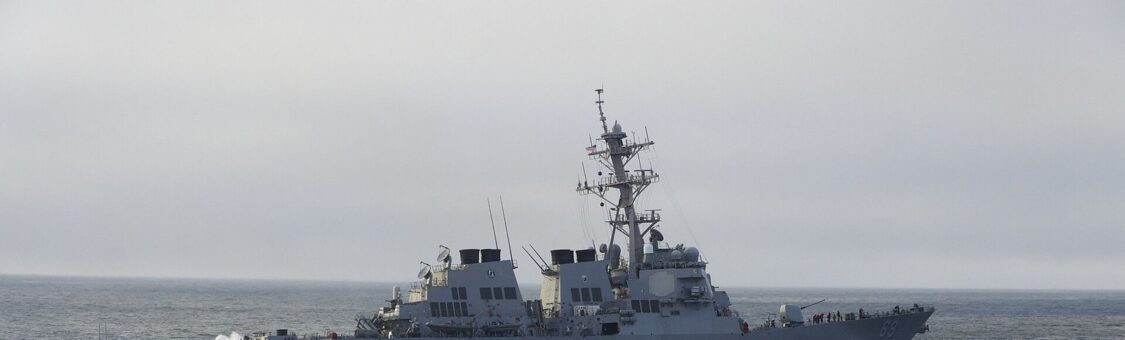
Navy destroyers massed in Middle East as maintenance backlogs strain fleet
US Navy 111011-N-ZC343-470 The guided-missile destroyer USS Milius (DDG 69) practices an emergency breakaway during an underway replenishment with.jpg Photo: U.S. Navy photo by Senior Chief Mass Communication Specialist Joe Kane

Navy destroyers massed in Middle East as maintenance backlogs strain fleet

As of Sept. 14, two Navy guided-missile destroyers were operating in the Red Sea and another 13 were in the Arabian Sea, according to the U.S. Naval Institute’s fleet tracker, which uses Navy and public data. The concentration comes as U.S. forces conduct operations against Iran, according to U.S. Central Command, placing renewed operational demands on a destroyer fleet that has experienced prolonged maintenance periods.

The demand on the Arleigh Burke-class has been significant even before the current conflict. The USS Carney spent 235 days deployed from September 2023 to May 2024 and conducted 51 engagements against Houthi-launched weapons, according to the Navy. When Carney returned in May 2024, then-Chief of Naval Operations Adm. Lisa Franchetti told the crew the last time the Navy had directly engaged an enemy to that degree was during World War II.

The renewed demand comes as the Navy’s maintenance system has struggled to keep the fleet on schedule. A December 2025 Congressional Budget Office analysis of Navy maintenance data found that Arleigh Burke-class destroyer overhauls that began between 2011 and 2024 took an average of 26% longer than the Navy’s final schedules estimated. The 225 DDG-51 overhauls analyzed also required 8% more labor than scheduled.

CBO projected that DDG-51 destroyers will spend an average of more than nine years, or about 27% of their planned service lives, in maintenance — more than twice the roughly four years envisioned in the Navy’s 2012 class maintenance plans. The agency cited the aging fleet, postponed maintenance, late inspections and contract awards, unexpected additional work, delays in parts and materials, and modernization work as factors. The average age of the DDG-51 fleet rose from 10 years in 2011 to 20 years in 2024.

The Government Accountability Office, in a January 2025 review, found that the Navy requested nearly $24.9 billion for combat-surface-ship maintenance from fiscal 2020 through 2023 and reported that nearly $25.9 billion was appropriated. The Navy reported obligating 99.7% of that funding by the end of fiscal 2023, yet GAO found the service continued to face shortages of spare parts, insufficient qualified maintenance personnel, and a continuing need to defer maintenance.

U.S. Fleet Forces Command declined to discuss its current destroyer readiness posture, current operations, or potential effects on future deployment schedules, citing operational-security and classification guidelines. The command also declined to provide historical aggregate data on destroyer operational tempo.

Sources: DVIDS News · Defense News