News

News

Two Canadian generals compete for top NATO military post
160211-D-DT527-007 NATO country flags wave at the entrance of NATO headquarters in Brussels 2016.JPG Photo: Senior Master Sgt. Adrian Cadiz

Two Canadian generals compete for top NATO military post

Two Canadian generals are competing for NATO’s top military position, the chair of the NATO Military Committee, according to the Ottawa Citizen.

Chief of the Defence Staff Gen. Jennie Carignan and retired Lt.-Gen. Mike Breuer are both candidates for the post, the newspaper reported. The Military Committee chair is the alliance’s most senior military officer and advises NATO’s political leadership.

The Ottawa Citizen said the two Canadians are among several candidates for the position. NATO ambassadors are expected to vote on the appointment, with the winner serving a three-year term.

Carignan became Canada’s chief of defence staff in July 2024, the first woman to hold the job.

The selection process involves a vote by NATO’s 32 member nations. The Ottawa Citizen did not specify when the vote will take place or how many candidates are in the race.

If either Canadian wins, it would mark the first time a Canadian has held the Military Committee chair.

Sources: Ottawa Citizen · Ottawa Citizen

News

Iran War Cost $38B Through August, Depleted Interceptor Stocks, CBO Says
US Navy 030320-N-6141B-003 Tomahawk Land Attack Missiles (TLAM) launch from the ship's forward and aft MK-41 vertical launch systems (VLS) aboard the guided missile destroyer USS Donald Cook (DDG 75). Photo: U.S. Navy photo by Chief Journalist Alan J. Baribeau.

Iran War Cost $38B Through August, Depleted Interceptor Stocks, CBO Says

U.S. combat operations against Iran have cost at least $38 billion through Aug. 1 and could cost up to $3 billion a month as the conflict continues, according to an analysis released Tuesday by the Congressional Budget Office.

The estimate covers the price tag of the conflict through Aug. 1 and reflects the costs of replacing expended munitions and equipment lost in battle, increased flying hours and other operations and increased fuel costs, the CBO said. It does not account for damage inflicted by Iranian strikes on U.S. bases across the Middle East, according to the agency, which noted that the Pentagon did not respond to its requests for information.

The majority of the expenses, nearly $22 billion, are for the expenditure of munitions, including $13.1 billion for missile defense interceptors used to counter Iranian missile and drone attacks, according to the agency. The CBO said the U.S. has probably used between one-half to two-thirds of its inventory of certain interceptors since June 2025, when the U.S. joined Israel in bombing Iranian nuclear sites and intercepted retaliatory Iranian attacks.

Rebuilding the Pentagon’s inventory of interceptors would probably take at least five years, even if currently low production rates are increased, the agency stated in a letter to Rep. Brendan Boyle, D-Pa.

The CBO estimated that an additional month of the war at the level of low and sporadic violence seen in May and June would cost about $2 billion. If the conflict’s intensity ramps up, as it did in July, the monthly cost would increase to $3 billion.

Its calculations show that the Pentagon’s second-largest war expense has been increased flying hours, which have cost nearly $11 billion. The CBO also estimated $1.9 billion in equipment losses and $3 billion in additional fuel costs, attributing part of the increase to higher energy prices caused by Iran’s closure of the Strait of Hormuz.

The findings align with estimates the Defense Department’s inspector general delivered to Congress on Monday. That report said the war cost the U.S. at least $33.4 billion as of June 29 and resulted in “strategic inventory shortfalls” of critical munitions. It also cited the loss of dozens of U.S. military aircraft and damage to hundreds of buildings.

The IG report said the $33.4 billion figure includes $7.4 billion in “cumulative obligations” for the operation, $22.3 billion in used munitions, and $3.7 billion in equipment losses. That total does not include the costs of infrastructure damage, which are likely to be significant: “Iranian strikes damaged and destroyed hundreds of buildings and structures at U.S. bases in Kuwait, Bahrain, Qatar, UAE, Saudi Arabia, Iraq, Oman, and Jordan during the conflict,” per the IG report.

Key operational costs include “airlift operations ($929.6 million), the Flying Hour Program ($691.1 million), mission and other ship operations ($647.7 million), base support ($405.0 million), and maneuver units ($385.3 million).” On the personnel front, 417 service members were wounded and seven were killed during the operation, according to the IG.

The IG report appears to be the first official, public notice that DoD officials are worried about stockpile depth: “The Office of the Under Secretary for Acquisition and Sustainment (OUSW[A&S]) said that the munitions expenditure in OEF has resulted in strategic inventory shortfalls and revealed industrial base bottlenecks for munitions resupply.” A&S officials specifically called out “the production of solid rocket motors, the availability of high-grade explosives and propellants, and the recruitment of skilled manufacturing labor” as key issues.

The White House asked Congress in June to approve $87.6 billion in emergency supplemental funding tied, in large part, to the ongoing conflict with Iran, including $21 billion to replenish depleted munitions. That request has made little headway in Congress ahead of the midterm elections. House Republicans narrowly approved a budget resolution in July that would provide the Pentagon with the funds but the Senate has yet to act on the proposal.

Chief Pentagon spokesman Sean Parnell said in a statement Tuesday that “claims of U.S. munition shortages are false.” President Donald Trump and Defense Secretary Pete Hegseth have also denied that the U.S. is running low on key munitions.

The CBO’s report excludes future repair and maintenance costs for equipment used in the conflict. It also does not include costs associated with the 18 service members who have died in the conflict as well as potential increases in veterans’ health care and disability compensation for the more than 800 troops who have been wounded. More than 50,000 U.S. service members are deployed to the Middle East to support the war, which was jointly launched by the U.S. and Israel in February.

Sources: Breaking Defense · Air Force Times

News

Navy Awards $562M Contract for First MQ-25A Stingray Production Drones
An F-A-18C Hornet launches from the flight deck of the conventionally powered aircraft carrier.jpg Photo: U.S. Navy photo by Photographer's Mate 3rd Class Jonathan Chandler

Navy Awards $562M Contract for First MQ-25A Stingray Production Drones

The U.S. Navy has awarded Boeing a $562 million contract to begin low-rate production of the MQ-25A Stingray, the service’s first carrier-based unmanned refueling drone. The Fixed Price Incentive contract covers three Lot 1 aircraft and includes advance funding to buy long-lead components for three more Lot 2 aircraft. Boeing expects to deliver the first Lot 1 aircraft in 2029.

“Awarding this first LRIP contract marks a pivotal transition from development to operational reality and is a testament to the focused effort of our joint government and industry teams,” said Capt. Daniel Fucito, Unmanned Carrier Aviation program manager. “MQ-25A will deliver the advanced reach, lethality, and survivability our warfighters need to outpace evolving threats and dominate the future battlespace,” Fucito said.

The contract follows a Milestone C decision in May, when Acting Secretary of the Navy Hung Cao approved moving the MQ-25A into full production and deployment. That approval cleared the way for the Navy to commit funding beyond the test and development aircraft already under contract.

The MQ-25A is designed to fly aerial refueling missions from aircraft carriers, a job currently handled in part by manned F/A-18E/F Super Hornets. Freeing those jets from tanker duty lets them fly more strike missions and reduces wear on the Super Hornet fleet, extending its service life.

The Navy’s program of record calls for 76 MQ-25A aircraft total, including four Engineering Development and Manufacturing airframes and five System Demonstration Test Articles built earlier in the program. Seven test aircraft are currently in production, split between Boeing’s St. Louis facility and a dedicated MQ-25 production line in Mascoutah, Illinois.

The Stingray is built to operate as the first fully integrated unmanned aircraft flying routinely from a carrier deck alongside manned jets. The Navy has described the program as a template for how unmanned aircraft will be folded into carrier air wings going forward, beyond the tanking mission the MQ-25A is starting with. Program office PMA-268 oversees both the MQ-25A air vehicle and the ground-based Unmanned Carrier Aviation Mission Control System used to command and control it.

Sources: Defence Blog · Stars and Stripes

News

Air Force Targets 500 Massed Modular Aircraft by 2032 as Industry Unveils New Drones
436th MGG CPI office SUAS drone pilots log flight time Photo: Roland Balik

Air Force Targets 500 Massed Modular Aircraft by 2032 as Industry Unveils New Drones

The U.S. Air Force plans to field 100 new low-cost, long-range autonomous aircraft by 2029 and 500 by 2032, according to officials speaking at the Air, Space & Cyber Conference in Washington, D.C., this week. The service’s Massed Modular Aircraft effort is drawing new industry offerings, including Swarm Aero’s Gamera and Lockheed Martin’s expanded Vectis program.

Swarm Aero unveiled its Gamera aircraft at the conference, a Group 5 uncrewed system with roughly the wingspan of a Boeing 737, a projected unrefueled range of 9,000 nautical miles, and seven hardpoints for weapons and sensors. The company says Gamera can carry long-range weapons such as the Long-Range Anti-Ship Missile and Joint Air-to-Surface Standoff Missile-Extended Range, with more than 2,800 pounds of payload capacity. Gamera has not yet flown, and Swarm Aero has not demonstrated its projected range, cost, or operational performance.

Swarm Aero CEO Peter Kalogiannis and Chief Revenue Officer Oliver Palmer told Military.com they founded the company in 2022 and began pursuing the concept about four years before the Air Force publicly articulated the requirement. “This is a very risky go-to-market motion,” Palmer said. “As a startup, we bet that the customers would get there.” The company also showcased its Legion command-and-control software, which Palmer said allows a single operator with relatively short training to control dozens of live assets in complex operations. Swarm was one of three companies selected from roughly 130 considered for command-and-control software under the Pentagon’s Replicator initiative, Palmer said.

Lockheed Martin’s Skunk Works division announced it will build four additional Vectis collaborative combat aircraft beyond the first prototype already under construction, bringing the planned fleet to five aircraft. The company displayed a full-scale Vectis model for the first time at the conference. Ron Fehlen, vice president and general manager of Skunk Works, called the expansion a “strategic investment to accelerate the production progress and the maturity of Vectis.” He said the development work on the four additional vehicles is underway, with the company intending to build and fly them faster than the first prototype. Vectis remains on track for a first flight by the end of 2027.

The Vectis aircraft is approximately 34 feet long with a wingspan of about 38 feet, featuring a tailless lambda wing design and a submerged air inlet. Lockheed says the design reduces drag and lowers the risk of foreign object debris ingestion when operating from austere locations. The company says it has used a manufacturing technique called minimal tooling determinant assembly, which Fehlen said reduced labor hours by as much as 80 percent and increased first-pass yield.

Air Force Chief of Staff Gen. Ken Wilsbach told the conference that recent combat operations demonstrated the importance of integrating aircraft, weapons, people, and information rather than viewing individual platforms in isolation. “We must be ready to fight, built to endure, and integrated to win,” Wilsbach said. “When we pair manned aircraft with low-cost autonomous systems, we will be able to unlock combat power at scale,” Meink said.

Meink said, “Because of the steps we’re taking today, we’ll have a radically different looking Air Force by 2032.”

Sources: The Aviationist · Shephard Media

News

US Acknowledges for the First Time That It Has Deployed Weapons in Space
Combined Space Operations Center - Combat Delta 1-5 Operators Monitoring Space Effects Displays (9718592).jpg Photo: U.S. Space Force photo by David Dozoretz

US Acknowledges for the First Time That It Has Deployed Weapons in Space

WASHINGTON — Air Force Secretary Troy Meink publicly acknowledged for the first time that the United States has deployed offensive weapons in orbit, confirming that the Space Force has “space control weapons” capable of defending against hostile adversaries.

Meink made the announcement during a keynote address at the Air & Space Forces Association’s Air, Space & Cyber Conference at National Harbor, Maryland, on Monday. He said the US now has “on-orbit space control weapons capable of defending the joint force against hostile adversary actions.”

“It is critically important that we maintain our dominance, not only in the air but in space,” Meink said, according to Air & Space Forces Magazine. He added that if threatened, “we can take of that.”

The acknowledgment marks the first time the US military has publicly stated it has deployed weapons in space. The specific systems and their deployment timeline were not disclosed.

A Space Force spokesperson told Task & Purpose that the US “currently has on-orbit capabilities to meet the needs of the Joint Force.” The spokesperson did not provide specifics but said space control “encapsulates the mission areas required to contest and control the space domain — employing kinetic and non-kinetic means to affect adversary capabilities through disruption, degradation and even destruction, if necessary.”

The Outer Space Treaty, signed in 1967, bars the deployment of weapons of mass destruction such as nuclear missiles into orbit. The Space Force’s statement said military operations in space are in compliance with the treaty.

Meink’s remarks follow months of discussion about the Space Force building out its offensive capabilities in space.

“This is why the United States now has on-orbit space control weapons capable of defending the joint force against hostile adversary actions,” Meink said during his speech.

The Space Force’s statement to Task & Purpose echoed Meink’s remarks, confirming the on-orbit capabilities without detailing their nature or purpose.

Sources: DVIDS News · Task & Purpose

News

NASA Chief: Moon Race Against China Is a National Security Priority
NASA's Orion test vehicle rollout at Cape Canaveral Photo: TSgt Dalton Williams

NASA Chief: Moon Race Against China Is a National Security Priority

NASA Administrator Bill Nelson said Sept. 15 that the race to the Moon carries national security stakes, explicitly linking the Artemis program to strategic competition with China. Nelson said the U.S. cannot afford to fall behind China in lunar exploration.

Nelson pointed to China’s stated goal of landing astronauts on the Moon by 2030 and its buildup of orbital infrastructure, including the Tiangong space station, as evidence of Beijing’s intent to dominate cislunar space.

Nelson emphasized that the Artemis program, which aims to return astronauts to the Moon, is now viewed by the administration as a critical component of U.S. national security strategy.

The administrator’s national security framing is expected to bolster support for the program among defense hawks in both parties.

Sources: Air & Space Forces Magazine

News

Air Force’s Havoc Spear Cruise Missile Cleared for Wider Use After First Combat Test
AC-130 (5872).jpg Photo: MSgt Christopher Boitz

Air Force’s Havoc Spear Cruise Missile Cleared for Wider Use After First Combat Test

The U.S. Air Force’s developmental AGM-190A Havoc Spear cruise missile has passed its first live combat evaluation and is now cleared for broader use across special operations and conventional aircraft, Air Force Special Operations Command announced.

The missile was launched from a C-130 aircraft in a test configuration during a spring 2026 operation under U.S. Africa Command. Officials said the missile performed accurately and met AFSOC’s requirements for a small cruise missile, clearing the way for wider fielding.

AFSOC first publicly revealed the missile’s name in May 2026 at the Special Operations Forces Week conference in Tampa, Florida, where officials described it as capable of delivering long-range precision strikes with both kinetic and non-kinetic effects.

The Havoc Spear is designed to be modular and mission-adaptable, allowing operators to configure it for different targets or effects. The design is intended to keep production costs and timelines down compared with older cruise missiles.

Development skipped much of the traditional acquisition process. U.S. Special Operations Command led the effort on AFSOC’s behalf using a cooperative research and development agreement, or CRADA, with an industry partner rather than a standard program of record. That approach allowed the missile to move from design through combat testing in under three years, compared with the five to seven years such programs typically take.

U.S. Air Force Lt. Gen. Conley said the missile’s range and capabilities expand standoff options, giving commanders a versatile tool to neutralize threats without putting platforms or personnel in immediate danger. “It’s also not lost on us the value of being able to test a new weapon system in combat, and prove its success on the battlefield early on in the process,” Conley said.

The decision to run the evaluation through AFRICOM ties the missile’s early record to one of the U.S. military’s key counterterrorism theaters. “We work every day to disrupt the networks that have made Africa the epicenter of global terrorism,” said U.S. Air Force Gen. … “These successful operational assessments prove we will continue to bring the unique capabilities only the U.S. …”

Air Force Col. Robert Johnston, AFSOC director of strategic plans, programs and requirements, also commented on the milestone.

AFSOC has not disclosed the missile’s cost, its production rate, or which aircraft beyond the C-130 used in the AFRICOM evaluation will carry Havoc Spear as it moves toward wider use.

Sources: Defence Blog · DVIDS News

News

CBO: Iran War Cost $38B, Depleted Up to Two-Thirds of Key Missile Interceptors
Missile launch from DDG-51.jpg Photo: Capt. Seiko Okano, AMDR Program Manager, Integrated Warfare Systems (IWS), U.S. Naval Sea Systems Command

CBO: Iran War Cost $38B, Depleted Up to Two-Thirds of Key Missile Interceptors

The U.S. military has incurred about $38 billion in costs from combat operations against Iran through Aug. 1, and the conflict has consumed between one-half and two-thirds of the U.S. inventory of certain missile-defense interceptors since June 2025, according to a Congressional Budget Office analysis released Sept. 15.

The estimate includes Patriot, Terminal High Altitude Area Defense (THAAD), Standard Missile-3 and Standard Missile-6 interceptors. CBO said the Pentagon does not disclose how many interceptors it has in inventory; analysts compared reported expenditures with the total number of missiles the Defense Department has purchased to estimate usage. The estimate applies to the combined inventory of those four systems.

Rebuilding those stocks could take at least five years, even if production rates increase, the agency found. The interceptors accounted for $13.1 billion of the $21.7 billion CBO estimates the Pentagon would need to replace in munitions expended through Aug. 1. Land-attack cruise missiles accounted for another $7.3 billion, with $1.2 billion for other munitions.

CBO estimates unit costs of roughly $4 million for a Patriot or SM-6, $12 million for a THAAD interceptor and $28 million for a sophisticated SM-3. The agency said the United States has already used significant quantities of these weapons defending Israel and then expended more during Operation Epic Fury.

The $38 billion figure includes expended munitions, equipment losses, increased flying hours, other operations and higher fuel costs. It does not include costs borne by other federal agencies or military operating costs already included in the federal budget. The highest costs beyond munitions were $10.4 billion for increased flying hours, $2.7 billion for fuel and $1.9 billion to replace equipment lost in battle, including a THAAD radar destroyed by Iran.

A separate Defense Department inspector general report estimated the cost of the operation at $33.4 billion through June 29. The administration had requested $87.6 billion in supplemental funding in June, including $67.1 billion for the DoD, with $42.3 billion identified as directly related to the conflict—about 10% higher than CBO’s estimate.

CBO said the Pentagon did not respond to its requests for information, so analysts relied on government databases and public reports, and the estimate is subject to considerable uncertainty. The initial phase of Operation Epic Fury involved about 250 tactical aircraft, including roughly 90 from two carrier strike groups, as well as an amphibious ready group.

CBO estimates each additional month of fighting would cost roughly $2 billion to $3 billion if the intensity remains relatively low, with costs potentially higher if operations intensify. The depleted interceptor stocks could pose a particular problem in a conflict with China, CBO said, because Beijing maintains large numbers of ballistic and cruise missiles.

Sources: Defense News · Army Times

News

Arctic Commission Chair Has Reported Russia Ties, Business Conflicts
11th Airborne Division conducts training on Arctic Circle.jpg Photo: Pfc. Brandon Vasquez

Arctic Commission Chair Has Reported Russia Ties, Business Conflicts

President Donald Trump in December appointed Thomas Dans, a Texas venture capitalist and social media influencer with no formal science background, as chair of the U.S. Arctic Research Commission. Dans, who also serves as the administration’s main voice on Arctic policy, has used the position to advocate for a U.S. takeover of Greenland and closer ties with Russia, according to a Defense One report published September 15, 2026.

Dans has repeatedly called for more U.S. icebreakers and has specifically championed Damen Shipyards, a Dutch company with which he had a business relationship. At an event in Anchorage, Alaska, in April, Dans called Damen “the largest builder of icebreakers and ice-class vessels in the world.” At the time, his consultancy, Almiranta Strategies, was working to help Damen secure a federal icebreaker contract.

Dans has also advocated for improved U.S.-Russia relations. “We want a peaceful Arctic, we want a peaceful world,” he said days after announcing plans to travel to Moscow. “Russia and the United States gotta get along for that to happen.”

His public statements go beyond the commission’s scientific mandate, according to Fran Ulmer, who served as commission chair for more than nine years before Trump replaced her in 2020. “And certainly outside the bounds of what the U.S. Arctic Research Commission has done in the past,” Ulmer said.

Dans’ position grants him access to government information from other federal agencies, an arrangement that could benefit his private interests. Commission members are not considered government employees and are not required to file an ethics form disclosing conflicts. A White House official told ProPublica that Dans’ consulting work did not constitute a conflict of interest for that reason.

“Tom Dans is doing a great job leading the Arctic Research Commission, and his shipbuilding expertise has helped him succeed in this role,” said White House spokesperson Anna Kelly. “The President appreciates all he is doing to advance American interests in the Arctic.”

Dans has long-standing ties to Russia, dating to seventh grade when he was recruited to learn Russian in a Maryland public school. He later worked in finance in Moscow in the mid-1990s and served on a secret National Security Council task force on U.S. control of Greenland during Trump’s first term. Trump first named Dans to the commission in late 2020, but the Biden administration fired him and three other appointees in 2021.

Dans declined multiple interview requests and did not respond to written questions from ProPublica. He told The New York Times this year that his post did not preclude him from working in private business.

Context

The Arctic region is warming at unprecedented rates, with Russia and China conducting joint military exercises in the far north and new shipping lanes opening. Dans is one of two commission members the law designates as representatives of “the interests of industry.”

Sources: Defense One

News

Zelenskyy warns Canada-U.S. tensions are ‘dangerous,’ urges dialogue
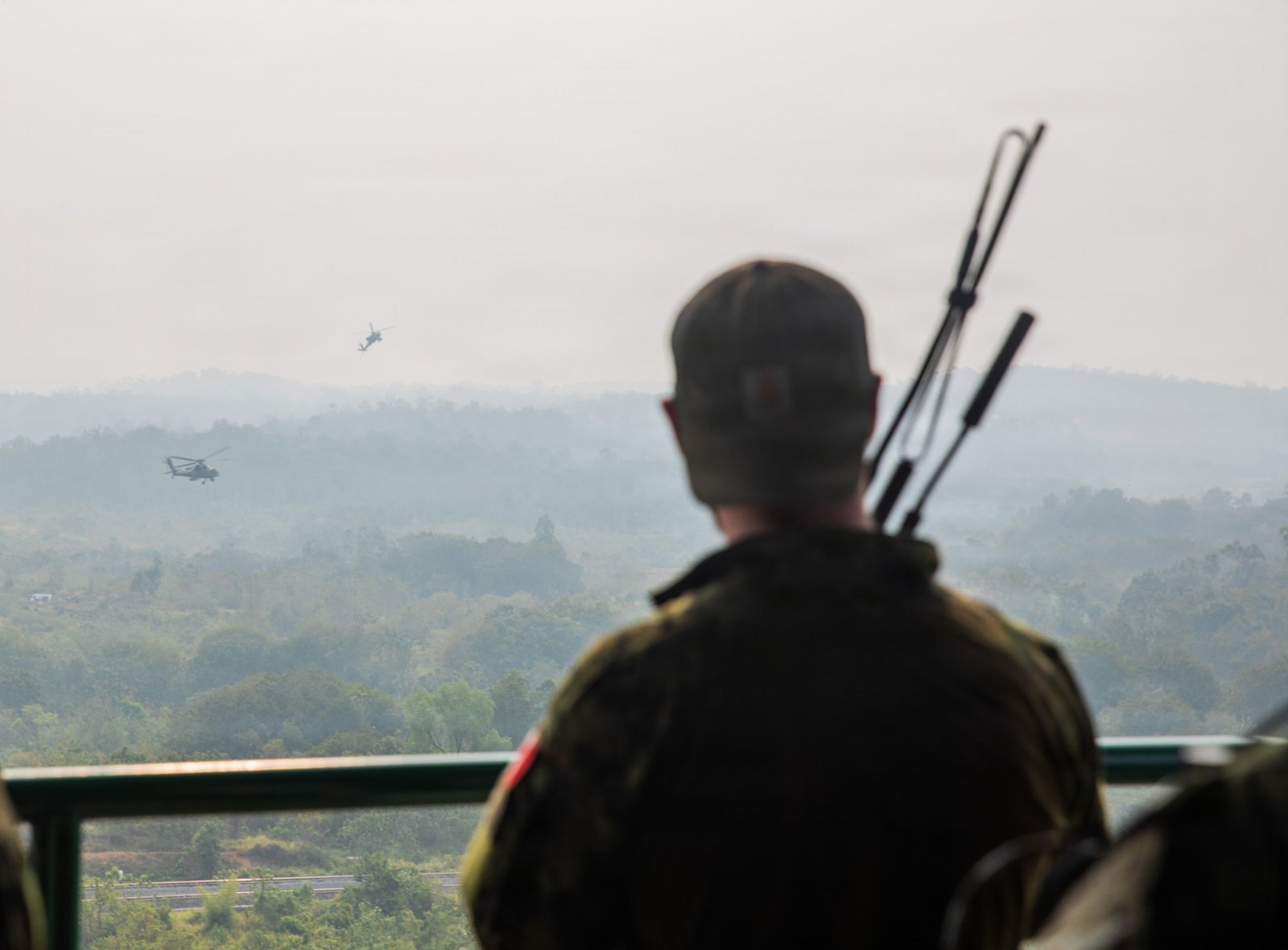
Canadian Service Member Assists with Coordinating Apache Fire Mission Photo: SGT Zachary Johnson

Zelenskyy warns Canada-U.S. tensions are ‘dangerous,’ urges dialogue

Ukrainian President Volodymyr Zelenskyy described the deteriorating relationship between Canada and the United States as “strange” and “very dangerous” during an exclusive interview with CBC’s chief correspondent Adrienne Arsenault at the end of his visit to Canada last week. Zelenskyy urged Ottawa and Washington to keep dialogue going to work out their differences, but three times referred to the ongoing trade war and associated rhetoric as “dangerous.”

Zelenskyy drew a direct comparison between Canada’s situation and Ukraine’s experience with Russia, saying, “We are the example.” He noted that while the United States has not threatened Canada militarily, no American divisions are assembling at the border, and no Canadian territory has been annexed, the rhetoric and economic pressure echo patterns seen in Ukraine’s relationship with Russia.

Prime Minister Mark Carney has alluded to the stakes, saying U.S. President Donald Trump “wants to break us, so he can own us.” Former deputy prime minister Chrystia Freeland, who remains an economic adviser to Zelenskyy, has described the Trump administration as an “existential threat” to Canada’s future. Retired vice-admiral Mark Norman, former vice-chief of the defence staff, posed the question: “Are we as Canadians any different than Ukraine is to Russia or Taiwan to China?”

The comparison has been made more explicitly outside Canada. A March 2025 Washington Post analysis asked, “As Putin sees Ukraine … Trump sees Canada?” arguing that Trump’s rhetoric toward Canada parallels Putin’s attitude toward Ukraine. A subsequent Post commentary said Trump talks about Canada as though it were a wayward province rather than a fully separate country. An article in The Atlantic in September 2026 described Trump’s approach to Canada as reflecting a worldview in which sovereign countries can be treated almost as properties to be controlled, explicitly drawing a parallel between Trump’s apparent disregard for Canadian sovereignty and Putin’s attitude toward Ukraine.

Dominique Arel, chair of Ukrainian studies at the University of Ottawa, noted that Ukraine was extraordinarily dependent on Russia for energy after the Soviet Union’s collapse and has been “with a gun at its head” since the 2014 annexation of Crimea. He said parallels can be drawn to Canada’s deep integration with the United States, including supply chains, energy, defence production, intelligence, and continental security.

Canada is set to co-host a conference with Norway on returning Ukrainian children and detainees, according to Global News. The conference follows Canada and Ukraine forging a 100-year pact built on drones and defence, as reported by CBC.

Sources: Global News Canada · CBC Politics