News

News

Navy carrier remotely controls MQ-25A Stingray over 2,100 miles in Pacific trial
MQ-25 T1 Stingray test aircraft takes off.jpg Photo: U.S. Navy photo courtesy of Boeing

Navy carrier remotely controls MQ-25A Stingray over 2,100 miles in Pacific trial

The U.S. Navy said an aircraft carrier remotely controlled an MQ-25A Stingray unmanned refueling aircraft from more than 2,100 miles away, using a satellite link during a test in the Pacific Ocean.

Acting Secretary of the Navy Hung Cao announced the trial on Oct. 19, 2026. During the Preliminary Sea Trial aboard the Nimitz-class carrier USS Ronald Reagan (CVN 76), the ship’s Unmanned Air Warfare Center connected to an MQ-25A test aircraft at Boeing’s facility in Mascoutah, Illinois, through a Proliferated Low Earth Orbit (pLEO) satellite network. The aircraft was controlled from the ship’s MD-5C Ground Control Station.

The Navy described the event as a first and part of a series of build-up exercises designed to validate procedures, networks and interfaces. The release did not specify when the test took place or which Stingray airframe was used. Previously, the Unmanned Carrier Aviation Program Office’s (PMA-268) Unmanned Carrier Aviation Mission Control System team had conducted pier-side and at-sea tests with the MQ-25 Integrated Test Team, which includes the U.S. Navy, Boeing and Lockheed Martin.

The MD-5C Ground Control Station integrates the Navy’s Command, Control, Communications, Computers and Intelligence (C4I) network with Lockheed Martin’s MDCX hardware and software, according to the Navy. The system will also provide command and control for the Navy’s future unmanned carrier aircraft and the Air Wing of the Future.

“We have redefined naval power projection,” said Capt. Daniel Fucito, PMA-268’s program manager. “This first-ever underway connection between a carrier-based UAWC and an MQ-25A aircraft proves that the Carrier Air Wing of tomorrow is a reality today.”

Cao said the Stingray’s carrier-based refueling capabilities enable F/A-18 Super Hornets to fly farther and longer. “The integration of this unmanned aerial refueler demonstrates the transformational change our manned and unmanned asset integration provides the Fleet,” he said in the Navy release.

In a separate milestone announced by Boeing on Oct. 6, the Stingray moved closer to teaming with fleet aircraft: the company said it successfully tested Manned-Unmanned Teaming (MUM-T) command and control software using the Link 16 datalink during the Emerald Flag exercise at Eglin Air Force Base, Florida. The software was installed on a Beechcraft 1900D and a King Air E90 for the demonstration. Boeing plans to integrate the capability with the MQ-25A and F/A-18 Super Hornet after further testing.

The test is broadly in line with the Navy’s previous timeline to achieve MQ-25A carrier integration by 2026, according to The Aviationist. In 2024, the USS George H.W. Bush (CVN 77) became the first carrier to receive an Unmanned Air Warfare Center with an MD-5E Ground Control Station. In September 2026, the Navy awarded Boeing a $562 million contract for Lot 1 of the Stingray’s Low-Rate Initial Production, bringing the total number of Stingrays under contract to 14.

The Navy said the MQ-25A, described as the world’s first fully integrated carrier-based unmanned aerial vehicle, serves as a pathfinder for future unmanned carrier aviation. The service said the Stingray will provide the Carrier Air Wing with organic refueling, allowing more F/A-18E/F aircraft to focus on strike missions and expand the air wing’s operational reach.

Sources: The Aviationist · Defence Blog

News

Navy quadruples AI-enabled maintenance contract to $300M for repair robots
See SPOT innovate; PHNSY & IMF test next generation robotics Photo: Kenny Jones

Navy quadruples AI-enabled maintenance contract to $300M for repair robots

The U.S. Navy has expanded its contract with Gecko Robotics for AI-enabled repair robots to a $300 million ceiling, scaling the technology from the Pacific Fleet to the Atlantic Surface Fleet.

Gecko Robotics announced the increase on Oct. 20, 2026, six months after the initial five-year agreement. That original deal carried a ceiling of $71 million, according to Gecko co-founder and President Troy Demmer, and covered 18 Pacific Fleet ships. Defense News reported the initial agreement as a $54 million indefinite delivery, indefinite quantity contract.

The expansion brings the total contract value to up to $300 million, Demmer said. The company uses drones, wall-climbing robots and fixed sensors to collect data on ship components, decks, welds and hulls, then applies AI tools to identify structural issues not visible to the naked eye.

A key piece of the technology is Gecko’s Komodo system, a ground-driving robot that assesses the condition of steel beneath a ship’s deck coating without stripping the coating away, using electromagnetic acoustic transducer technology to measure steel thickness.

“Gecko’s AI and robotic technology can save the U.S. Navy up to $8 million in repair costs per ship and return vessels to sea quicker by identifying structural issues up to 50 times faster than traditional methods — reducing inspections from months to days,” the company said in a release.

Demmer said the technology allows Navy engineers to know what needs repair before a maintenance period begins, while the ship is still in the water, reducing surprises that extend maintenance schedules.

The Navy has set a goal of reaching 80% fleet readiness by 2027, a target adopted by Chief of Naval Operations Adm. Daryl Caudle from his predecessor Adm. Lisa Franchetti. Caudle has said achieving this requires shorter maintenance cycles, increased spare-parts availability, improved training pipelines and targeted upgrades across the fleet.

Sources: DVIDS News · DefenseScoop

News

B-21 Raider’s True Wingspan Revealed by Satellite Image
B-21 Raider Refueling.jpg Photo: United States Air Force (photographer not specified)

B-21 Raider’s True Wingspan Revealed by Satellite Image

The B-21 Raider’s true dimensions have been determined from satellite imagery, with the stealth bomber measuring 152 feet in wingspan and 61 feet in length, according to a report from The War Zone published Oct. 19.

The measurements come from a Google Earth image of Edwards Air Force Base dated June 20, 2026. The image resolution, combined with Google Earth’s measurement tools, provided conclusive figures, though The War Zone noted the numbers are approximate, “give or take a few feet.”

The data places the B-21 at about 12% smaller than the B-2 Spirit bomber in both wingspan and length. The War Zone previously estimated the B-21’s top-end wingspan at 155 feet, and that analysis has narrowed over time.

The publication reported that false claims, including AI-generated and enthusiast-made fact sheets showing wingspans under 130 feet, have circulated on social media. The War Zone’s editor, Tyler Rogoway, had repeatedly disputed those figures publicly.

Design implications

According to The War Zone’s long-running analysis, the B-21 was designed with a “premium on range and affordability” and very low observability over massive payload. The 12% size reduction reflects shifted design priorities from its predecessor, including improved aerodynamics for high-altitude cruise, more fuel for its size, and two efficient engines instead of four.

The B-21 is nearly the same length as an F-15 fighter, which sounds bizarre for a large bomber.

Additional details

The satellite image also provided a better view of the aircraft’s exhaust configuration, showing deeply buried exhausts with large planar exit ramps and a chevron trailing edge over the exhaust aperture. The exhaust pathway appears black in the satellite image, a feature that was edited out of an official top-down photo released in April, according to the report.

“At least we can say with total confidence that the B-21 is smaller than its progenitor, but not by all that much — about 12% to be more exact.”

The War Zone reported that the size data reveals “nothing we don’t already know” about the program, with the aircraft’s extreme unrefueled range being the key design outcome.

Sources: The War Zone

News

China built more than twice US naval tonnage in 2024-25, Euronaval report says
80-G-363480 Chinese Warships.jpg Photo: Anonymous Unknown author

China built more than twice US naval tonnage in 2024-25, Euronaval report says

PARIS — China built more than twice the naval tonnage of the United States in the 2024-25 period, according to the World Defense Shipbuilding report published by Euronaval ahead of the 2026 naval defense show.

The combined tonnage of combat ships built by China in the two years through December 2025 amounted to 636,208 tons, compared to 270,509 tons for the United States, according to data compiled by Flottes de Combat and French maritime industry association Gican.

China accounted for more than a third of the global naval tonnage constructed in 2024-25, the report said. Global naval construction reached 1.47 million tons in 2024-25, up from 959,671 tons in the prior two years. The value of global naval construction was $123.9 billion, climbing from $81.8 billion in 2022-23.

The value of Chinese combat-vessel construction was $43.5 billion in the latest two-year period, compared with $26.8 billion for the U.S., the report said.

China reversed its position from 2022-23, when its naval yards produced 202,520 tons compared with 245,703 tons for the U.S., according to the previous edition of the report published in 2024.

As of Jan. 1, 2026, the U.S. fleet of combat vessels of more than 200 tons amounted to 3.11 million tons, compared to 1.44 million tons for China’s fleet. Two years earlier, the U.S. fleet was 3.22 million tons and China’s was 1.3 million tons.

Russia was in third place in naval construction in 2024-25 with 149,056 tons built, followed by India with 76,430 tons and Italy with 53,700 tons. Turkey, France, Japan, South Korea and Romania rounded out the top 10 of naval builders.

“We are seeing a fairly substantial expansion of naval forces, and consequently of shipbuilding,” said Philippe Missoffe, general director of Gican, in a press briefing. “We’re seeing an increase in power capabilities, particularly nuclear-powered attack submarines for example.”

U.S. lawmakers and congressional researchers have warned that China’s greater shipbuilding capacity, combined with delays and bottlenecks in U.S. naval shipbuilding, could hurt America’s ability to keep up with Beijing’s expanding fleet.

The four-day Euronaval show, the world’s biggest maritime-defense exhibition, is set to kick off in Paris on Nov. 3. The number of exhibitors will be more than 40% higher than in 2024, according to the organizers.

Sources: Defense News · Navy Times

News

F-22 pilot controls unmanned FQ-44 in flight in CCA milestone
F-22 Raptor flying at twilight 190728-F-VA182-1014.jpg Photo: 2nd Lt. Samuel Eckholm

F-22 pilot controls unmanned FQ-44 in flight in CCA milestone

An F-22 Raptor completed airborne tactical command and in-flight control of an unmanned YFQ-44A Collaborative Combat Aircraft earlier this month, the Air Force announced. The demonstration marked a step in the service’s effort to field “loyal wingmen” for its fighter fleet.

The F-22 pilot served as an airborne “quarterback,” issuing high-level directives to the Anduril-made Fury, according to the Air Force. The unmanned, semi-autonomous aircraft’s onboard autonomy software interpreted and executed the directives in real time, performing in-flight maneuvers and simulated combat tasks.

Personnel from the 412th Test Wing, 422nd Test and Evaluation Squadron, 309th Software Engineering Group, Experimental Operations Unit, F-22 System Program Office and the CCA Software Autonomy and Teaming Branch collaborated during the demonstration, the service said.

Secretary of the Air Force Troy Meink said in the announcement that the achievement “demonstrates what is possible when we are aligned with industry on a shared imperative: delivering capability to the warfighter at unprecedented speed.”

“We are driving urgency into every part of acquisition from rapid integration and flight learning to disciplined assessment, so we can turn promising technology into combat capability at the pace the threat demands,” Meink said.

The Air Force plans to use data from the event to inform software integration, developmental testing and further CCA concepts, the announcement said.

The test follows other CCA milestones. The service has said it intends to have 500 combat-ready, semi-autonomous systems by 2032, with an overall fleet size of 1,000. The Anduril-made Fury executed its first live-fire test in July, conducting an end-to-end, beyond-line-of-sight strike against a simulated target at Edwards Air Force Base, California.

The Air Force has also made progress with General Atomics’ FQ-42A Vengeance, another CCA platform in development.

Sources: The Aviationist · Defense News

News

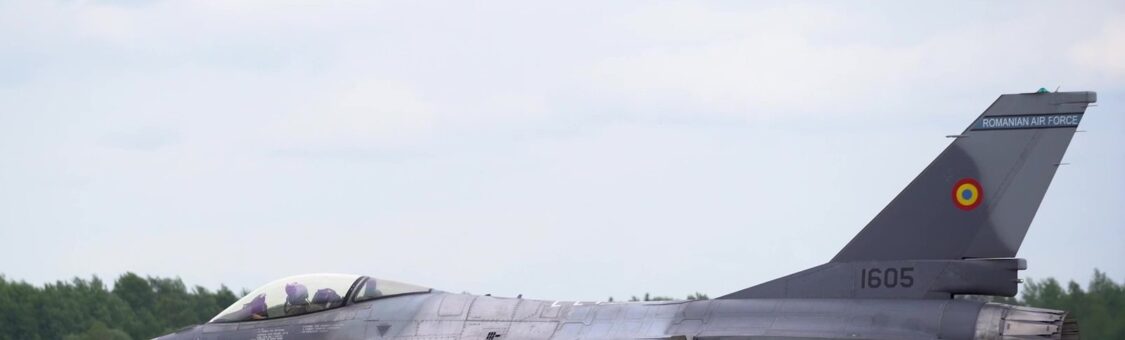
Romanian F-16s shoot down Russian drones over Black Sea as NATO prepares talks
Romanian F-16 at Šiauliai Air Base, Lithuania.jpg Photo: Courtesy of NATO’s Allied Air Command

Romanian F-16s shoot down Russian drones over Black Sea as NATO prepares talks

Two Romanian F-16 fighter jets shot down two suspected Russian-made Geran-4 drones inside Romanian airspace over the Black Sea on Saturday, Oct. 17, according to the Romanian Ministry of National Defence.

The drones entered Romanian airspace around 1800 local time (1500 UTC), the ministry said. The first drone spent about two minutes in Romanian airspace before being destroyed; the second remained for roughly five minutes. Two F-16s scrambled from the 86th Air Base at Borcea intercepted and destroyed the drones just 15-20 minutes after taking off, around 120 kilometers east of Snake Island.

Romanian Defence Minister and Deputy Prime Minister Radu Miruta said on Sunday, Oct. 18: “The ones from last night were flying at 450 km/h, which leads us to think they were Russian-made Geran-4 drones with a turboprop engine.” He added: “This is the first time we’ve shot down drones like these.”

The Geran-4 is an evolved variant of the Geran-2, Russia’s designation for Iran’s Shahed 136. Unlike the Geran-2’s piston engine, which allowed maximum speeds of around 115 mph, the Geran-4’s turbojet power unit allows speeds above 300 mph, according to The Aviationist. The Romanian ministry released images showing an F-16 firing an AIM-9 Sidewinder at one of the drones.

The incident comes ahead of high-level NATO talks on the Black Sea. On Thursday, Oct. 15, Romania’s Minister of Foreign Affairs Toiu Oana wrote: “In its war of aggression ag” — the statement was cut off in the source.

Last week, drones struck and severely damaged two chemical tankers off the coast of Romania, near where the two drones were downed, according to BBC reporting cited by The Aviationist. A “swarm” of Russian drones had been detected near Snake Island around the same time, and Russia later claimed responsibility for attacking two ships it said were supporting Ukraine’s war effort.

Neighboring Moldova has also reported a recent increase in drones found inside its territory. “These incidents pose a threat to citizens’ safety and show the direct consequences for regional stability of Russia’s aggressive war against Ukraine,” Moldova’s Foreign Ministry said, according to Reuters.

Separately, NATO’s Allied Command Transformation plans to buy six portable kits that can jam satellite navigation signals and drone control and video links for training. The request for proposals is planned for Oct. 26, 2026, with bids due Nov. 30 and a contract award expected Dec. 11, 2026, according to a notice posted by the U.S. Commerce Department.

Sources: Defence Blog · Stars and Stripes

News

Ukrainian drone unit caused 70% of US armored brigade casualties in first days of German exercise
1st Battalion, 4th Infantry Regiment, 7th Army Training Command use a STORK LR drone during Combined Resolve Photo: SGT Addison Shinn

Ukrainian drone unit caused 70% of US armored brigade casualties in first days of German exercise

Ukrainian drone operators playing the enemy in a U.S. Army training exercise in Germany caused about 70% of an American armored brigade’s casualties in the first three days, according to an account by the brigade’s own commander and staff.

The figures come from an article in Military Review, the U.S. Army’s professional journal, written by Col. Michael Ziegelhofer, commander of the 3rd Armored Brigade Combat Team, 1st Cavalry Division, known as “Greywolf,” and six of his officers. They describe Combined Resolve 26-07, held in spring 2026 at the Hohenfels Training Area in Bavaria, where the brigade fought an opposing force reinforced by a detachment from the 412th Regiment of Ukraine’s Unmanned Systems Forces, a unit known as “Nemesis.”

Enemy drones either struck Greywolf’s troops directly or spotted for artillery that did. Over the roughly 10-day rotation, the opposing force initiated contact with drones more than 750 times. By the end of the third day, the share of casualties caused by drones had fallen below 30%, and the authors say the enemy had not eased off. “Greywolf changed how it fought,” they wrote.

Much of that change came down to basic soldiering. The brigade’s counter-drone and electronic warfare systems jammed drone control signals in protective “bubbles” up to 2 km (1.2 miles) wide, but they had to be set up at fixed sites and moved forward in bounds, leaving units exposed on the move. The systems were also less effective against the smaller number of fiber-optic drones, which are guided through a thin cable and cannot be jammed. More than half the formation had to rely on cover, concealment, dispersion, smaller routes and fast battle drills to get away before artillery landed.

The authors estimate that roughly 60% of the counter-drone fight at brigade level is fieldcraft and drills. They said only the heavy simulated losses of the first days forced soldiers to apply what they had practiced. Survival came at a price: crews switched off Blue Force Tracker, cut radio use and even dropped Starshield satellite links to shrink their electronic signature, and resupplying the brigade took twice as long as planned because the enemy hunted its supply lines.

Greywolf also had drones of its own. For the offensive phase, it brought in the 3rd Battalion, 504th Parachute Infantry Regiment, then an experimental drone battalion, and employed more than 700 drones from platoon to brigade level. Using relay drones to extend their reach, nearly all of the battalion’s aircraft could fly 25 to 40 km (16 to 25 miles), enough to cover the entire training area, a box roughly 14 by 27 km.

That abundance initially swamped the brigade headquarters. Collection planning tools built for a handful of sensors broke down, the operations floor struggled to absorb the flood of reports, and an airspace system that opened and closed individual blocks for each drone could not keep up. The staff never had a complete picture of how many drones were in the air.

The brigade adapted by handing drone units clear priorities and letting them hunt within the commander’s intent instead of directing each aircraft. It moved its coordinated fire line forward of its cavalry squadron so drones and artillery could hit anything beyond it without extra clearance, made enemy drone ground control stations a top target, and held back part of its drone munitions for the decisive moment. Most crewed and uncrewed aircraft were separated by altitude, with narrow corridors reserved for attack helicopters and medical evacuation flights.

By the end of the rotation, Greywolf carried out two simultaneous breaches through dense forest about 6 km (3.7 miles) apart. The authors say the enemy could not tell which was the main effort, failed to stop either, and lost its reserve before committing it.

A company commander in the brigade, writing in Task & Purpose, described Nemesis drones already overhead as his company drove through the only gate into the training area.

“They showed us ways to effectively fly cheap drones incredible distances. They put on a masterclass in sensor-to-shooter kill chain management and speed using tactics, techniques, and technology that we can now use in our formations,” wrote Allan Watson.

The officers recommend that armored brigades house their drones in multifunctional strike troops, each with three platoons for long-range surveillance out to at least 40 km, medium and heavy bomber drones, and strike drones paired with relays, along with smaller armored strike platoons for each battalion. They also call for every drone in a brigade to share one common operational picture, pointing to Ukraine’s Delta battlefield management system as the model, and for counter-drone defenses that work on the move, from hard-kill protection on every vehicle up to brigade-level radar and defeat systems.

Ukrainian units and equipment have become a regular feature of U.S. Army training in Europe this year. Soldiers at Hohenfels were photographed during the following rotation, Combined Resolve 27-01, assembling a Ukrainian-designed Stork reconnaissance drone.

Sources: Defence Blog · DVIDS News

News

Democratic senators demand Pentagon disclose cost of Iran war damage to US bases
513th Expeditionary RED HORSE Welcomes New Commander - Lt Col David Schoenhardt Photo: A1C Kyle Jones

Democratic senators demand Pentagon disclose cost of Iran war damage to US bases

Democratic senators are demanding that the Pentagon publicly disclose the cost of damage to US military bases from the war with Iran, a figure that was presented in a classified briefing but has been withheld from the public, according to a report published Oct. 19, 2026, by Stars and Stripes.

The senators’ request follows a classified briefing in which the cost was revealed to lawmakers. The exact dollar amount has not been made public, and the Pentagon has not said why it is keeping the figure classified.

The war with Iran has involved attacks on US bases in the region, causing significant damage. The classified briefing provided lawmakers with an assessment of the costs, but the public has not been given access to the same figures.

Sources: Stars and Stripes

News

Trump appointees asked CISA to secretly hack a voting machine, former officials say
IVotronicVVPAT.jpg Photo: Douglas W. Jones

Trump appointees asked CISA to secretly hack a voting machine, former officials say

Political appointees at the Department of Homeland Security asked the Cybersecurity and Infrastructure Security Agency to secretly acquire a voting machine, hack it, and report the findings to the White House, according to two former administration officials with knowledge of the request.

The request was made a few months into President Donald Trump’s second term. The appointees wanted CISA to procure the machine, examine it, and provide the results to the White House, the officials said. One former official said the proposition was shocking to CISA’s career staffers, who feared they were being asked to take part in political interference.

“My thought was they could keep it in their back pocket to invalidate any [election] results they don’t like,” one of the former officials said. “This goes against everything CISA represents.”

The request also directed the agency not to alert the voting machine company if it uncovered flaws, contrary to standard practice. CISA employees repeatedly told the appointees the request was impossible, in part because the agents capable of such an operation had just been laid off by Elon Musk’s Department of Government Efficiency initiative. The appointees eventually stopped pressing CISA.

The request was not acted on, the officials said.

Agency staffing and budget cuts

In Trump’s second term, the administration has laid off or pushed out more than 1,000 CISA employees, shrinking the agency by about one-third. The president’s 2027 budget proposal would reduce funding for the agency by another $700 million, which could necessitate 900 additional layoffs, according to the report.

Democratic lawmakers have called for an investigation into CISA’s ability to do its job and demanded answers as to why federal funds are not being used to support election security as directed by Congress.

Several state election authorities said the agency provided them no assistance during the most critical planning stages for the upcoming midterms.

“There is a difference between deprioritizing and being nonexistent,” said Ryan Macias, an election technology and cybersecurity expert who has worked as a consultant for CISA. In 2025 and through mid-September 2026 — when the bulk of preparations for the election typically would have been completed — “they were nonexistent. Literally nonexistent.”

Though CISA re-emerged in September with a last-minute security plan for the election, some state officials said they fear that what is left of the agency has been compromised. In recent months, the Trump administration has declassified troves of records, including sensitive material that state officials provided to CISA. Some state authorities said they no longer trusted the administration enough to share information with CISA.

“They’ve violated the entire premise of that information-sharing relationship,” said one former high-ranking federal cybersecurity official who now advises state governments on national security. “There’s no fucking way they’re ever going to give any information to CISA. And it’s unclear if they ever will in the future.”

A White House spokesperson, Lauren Bis, defended Trump’s handling of election security in an emailed statement: “President Trump has done more than any other President to ensure we have free and fair elections.” DHS and CISA did not respond to interview requests or to a detailed list of questions.

Officials in one large voting jurisdiction said they have met privately with machine vendors to come up with a contingency plan if the federal government seizes their machines or declares them unusable.

“I don’t pay attention to what the president says. I pay attention to what his administration does,” Arizona Secretary of State Adrian Fontes said. “And what they’ve done is basically cut us off and left us on our own.”

Sources: Defense One

News

Fire at Canadian Base Kills 4 Soldiers Training for NATO, Injures Dozens
Canadian Infantry training in AZ.jpg Photo: U.S. Marine Corps photo by Cpl Benjamin R. Reynolds

Fire at Canadian Base Kills 4 Soldiers Training for NATO, Injures Dozens

A fire at Canadian Forces Base Wainwright on Saturday killed four Canadian soldiers and injured dozens more as they trained for a NATO deployment, according to Prime Minister Mark Carney. The fire broke out in a training area shortly after 4 p.m. during fierce winds, and the cause remains under investigation, though the military said there were no indications of terrorism.

Carney, in a televised address, said the soldiers were participating in military training when the fire started. He confirmed four deaths and said the wounded were being treated in Wainwright, Edmonton, Red Deer, and Calgary. The exact number of injured was not immediately clear.

Dr. Warren Thirsk, an emergency department physician at the Royal Alexandra Hospital in Edmonton, told CBC News that patients were taken to hospitals across the city as facilities around the base became “completely overwhelmed.” He described the situation as “a disaster” and “a one in every 15- to 25-year disaster.”

Emergency medical resources were stretched so thin that extremely few ambulances were available in the Edmonton area, and officials urged people to avoid the University of Alberta Hospital emergency department if possible. Wainwright Mayor Bruce Pugh said the town’s small hospital was not designed for a mass-casualty incident but praised local medical personnel. Helicopters and planes transported patients to other facilities, and at least 10 ambulances were parked at the Wainwright health center late Saturday.

The fire spread beyond the base into surrounding rural areas as winds gusted up to 100 kph (62 mph). By 11 p.m., the Municipal District of Wainwright said the fire was being held and property and critical infrastructure were protected. No evacuation order was issued for residents.

Defense Minister David McGuinty said the Royal Canadian Mounted Police were investigating and described the situation as “very, very active and delicate.” He said he could not recall “such an incident in recent memory.” Saskatchewan Premier Scott Moe said his province was sending unspecified assistance, and Alberta Premier Danielle Smith called the fire “significant and tragic.”

CFB Wainwright is one of Canada’s busiest military training bases, home to the Canadian Maneuver Training Center and the 3rd Canadian Division Training Centre, where soldiers prepare for combat operations, including NATO missions.

Flags will fly at half-staff on federal buildings across Canada in honor of those affected, Carney said. The investigation continues, and McGuinty said authorities expect to provide more information in the coming hours and days.

Sources: Military.com · US Army